Telegram bots for business: orders, support and the Linka Style example
Augustin Nicolau explains how a Telegram bot helps with orders, appointments, support and CRM. A real Linka Style example and custom development for different workflows.
Augustin NicolauADS Moldova Administrator

Contents
I am Augustin Nicolau, administrator of ADS Moldova. When a business owner asks us for a Telegram bot, my first question is straightforward: what do you repeat every day that you would like to make easier? For a shop, it might be processing orders. For a service business, it could be appointments, enquiries or passing information to the right person. A useful bot starts with that specific problem. It does not need dozens of features to justify its existence. This article explains where a bot can help, how it connects to the business and what we mean by custom development.
A real example: Linka Style — Comenzi
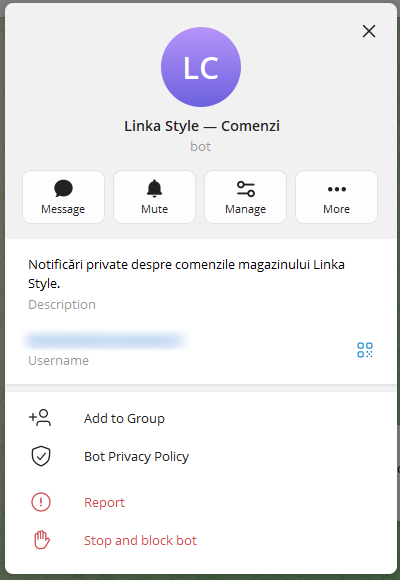
A real capture of the Linka Style bot profile, supplied for the project presentation. Its description identifies private Linka Style order notifications.
Open the screenshot at its original sizeThe screenshot shows “Linka Style — Comenzi”. Its description states its purpose: private notifications about orders from the Linka Style store. I like this example because the need is easy to understand. When an order appears, the person responsible needs to know and move on to processing it. Telegram becomes a familiar place to receive that signal, rather than another dashboard to check repeatedly. The capture shows the bot’s profile and stated purpose, not customer conversations. The workflow below illustrates how this kind of integration can be designed; it does not present invented order messages as evidence from the store.
What an order notification should contain
For an online shop, I would start with a short message: the order reference, selected products and variants, quantities, total and payment status. A button can open the order in the administration area, where an authorised employee checks the full details. There is usually no reason to copy the entire database record into a chat. A good notification explains what happened and where to continue. If an integration sends the same event twice, the system should recognise the duplicate. Otherwise, two messages might be mistaken for two separate sales. We agree these behaviours as part of the project, rather than leaving the team to work around them later.
An order, a payment and a shipment are different events
Creating an order does not necessarily mean that it has been paid. We distinguish between a new order, confirmed payment, preparation for dispatch and cancellation. Payment confirmation needs to come from the payment system, rather than an ordinary button click. Several important changes can trigger notifications, but not every technical update deserves a message. When a chat is constantly noisy, people start ignoring it. I prefer to identify the events that actually require attention and provide a clear next step. The online store, its order records and the bot should therefore be considered together, even when they are delivered in separate stages.
Appointments with an honest confirmation process
A salon, consultant or repair team can use a bot to collect booking requests. The customer chooses a service, leaves contact details and proposes a day or selects an available time. The distinction between a request and a confirmed booking matters. If there is a connected calendar, availability can be checked there. If an employee manages the schedule, the bot should say that the request has been received and awaits confirmation. That avoids a situation where the customer believes a slot is reserved while the specialist is already busy. We can also provide a way to amend the request or reach a person when the usual steps do not fit.
Better enquiries instead of messages without context
“Hello, how much does it cost?” is a conversation starter, but it rarely provides enough information for a quotation. A bot can ask a few short questions in order: the required service, location, preferred timing and contact method. For a website project, the current site and business goal are useful. For delivery, the area and preferred time may matter more. Questions should be brief and allow the person to go back. The employee then receives a coherent summary rather than starting the same conversation again. Details can also be saved in a connected CRM, alongside the source of the enquiry and its working status.
Customer support with a visible route to a person
Opening hours, delivery conditions, order stages and required documents often come up repeatedly. We can create a menu with answers and links to the current information. For more flexible conversations, we can integrate AI using material approved by the company. That does not mean every answer should be generated freely. A special price, disputed return or unusual request may need a colleague’s decision. The route to an operator should therefore be visible, with the original question preserved. Customers should not have to explain the same problem three times after moving between menus. Helpful automation reduces repetition and makes the handover understandable instead of promising an instant answer to everything.
A working tool for the team as well
A bot can also operate inside the company. It might alert the responsible employee to a new enquiry, an assigned task, an unfinished step or a short operational report. For a mobile team, receiving information in an application they already use can be more practical than introducing another dashboard. We define who receives each type of message and who can carry out each action. Receiving an alert should not automatically grant permission to modify an order. When a notification links to the administration area, that system’s normal authentication and user roles still apply. The bot provides a convenient route into the process, rather than unrestricted access to company records.
The types of Telegram bots we develop
At ADS Moldova, we develop any type of Telegram bot around a real business process, from a simple notification to a solution with several integrations. Our offer is not limited to one shop template. We can design:
- order notifications and internal team workflows;
- appointment requests, quotations and contact collection;
- customer support menus and AI assistants;
- educational material access and community tools;
- catalogues, documents, reports and Telegram Mini Apps.
The scope depends on the objective, available integrations and platform rules. Telegram’s feature documentation describes commands, buttons and Mini App interfaces. We turn those building blocks into a sequence that makes sense to the person using it, with clear messages and a useful result at the end.
Connecting the website and business records
The source of an event might be a website, form, CRM, calendar or product catalogue. Before agreeing an integration, we check which information the service allows us to read and which actions can be carried out with authorised access. For an enquiry, preserving its source, selected service and processing status can be useful. Copying the same information into several places without a main record usually creates confusion. We establish where the authoritative record remains and what happens when an external service is slow. Telegram is a convenient interface for notifications and selected actions; it does not have to replace every system the company already uses.
Relevant messages and appropriate access
A private notification bot and a public assistant serve different audiences. For the first, authorised recipients matter. For the second, the way a person starts the conversation and understands future messages is also important. Telegram explains that a bot cannot initiate a private conversation with someone who has not contacted it. We do not base a project on a promise to message anyone automatically. I would rather build a bot that sends expected messages with enough context and a clear action. We also choose which personal details belong in a notification and which should remain inside the authenticated business system.
How we work and what affects the cost
We begin by mapping the process: the trigger, information, recipients and intended result. Then we prepare the messages, commands and connections, and test both the normal route and cases where information is missing. Before launch, the team needs to know who administers the bot, how information is updated and where a problem should be reported. Cost depends on the number of workflows, external integrations, administration features, languages and any AI usage. The Telegram bot development page contains starting packages. For a custom project, we separately confirm the development scope, hosting and external services required to run it.
Where I would start
Choose one process that causes delays today: an order noticed late, an enquiry missing essential details or an appointment that takes too long to confirm. After launch, check the basics: do notifications reach the right recipient, are requests complete, can the team continue working and are failures visible? Add more features once that first process works. The Linka Style example shows a clear direction: order information delivered through a familiar working application. Your business may need something different, and we can develop a different kind of bot. Tell us what you want to simplify and which systems you already use; that is the starting point for a concrete solution and quotation.
Sources and documentation
Your notes
Notes stay in this browser.