StudioDeutsch: how we built a German tuition website
From the teacher’s profile to programmes, trial lessons, a blog and mini CRM. Augustin Nicolau presents StudioDeutsch and its PageSpeed reports: 95 on desktop, 74 on mobile.
Augustin NicolauADS Moldova founder
Contents
StudioDeutsch is built around a personal relationship: a teacher and someone who wants to learn German. Our starting point was to turn that relationship into a clear website where a prospective learner can understand the offer, meet the teacher and request a trial lesson without a complicated sequence of steps.
We created the public presentation, programme structure, blog, news section and a secure administration panel for the client, together with a mini CRM. The website is live and still in development. This article explains how those parts connect and includes two PageSpeed Insights reports: 95 for desktop performance and 74 on mobile, with 97 for accessibility, 100 for best practices and 100 for SEO in both captures.
A website that begins with the learner’s questions
Someone looking for German lessons usually needs more than a list of levels. They want to know who will teach them, whether they can start from the beginning, how lessons work and which programme fits their goal. We organised the StudioDeutsch presentation around those questions so interest can move naturally towards a conversation with the teacher.
On the StudioDeutsch website, the teacher’s introduction, programmes and trial lesson follow an understandable sequence. The order of information matters. A visitor should be able to decide whether the offer is relevant without reading every page first. Each section needs to answer a question and prepare the next step while leaving room to explore and return to useful information.
The teacher at the centre of the project’s identity
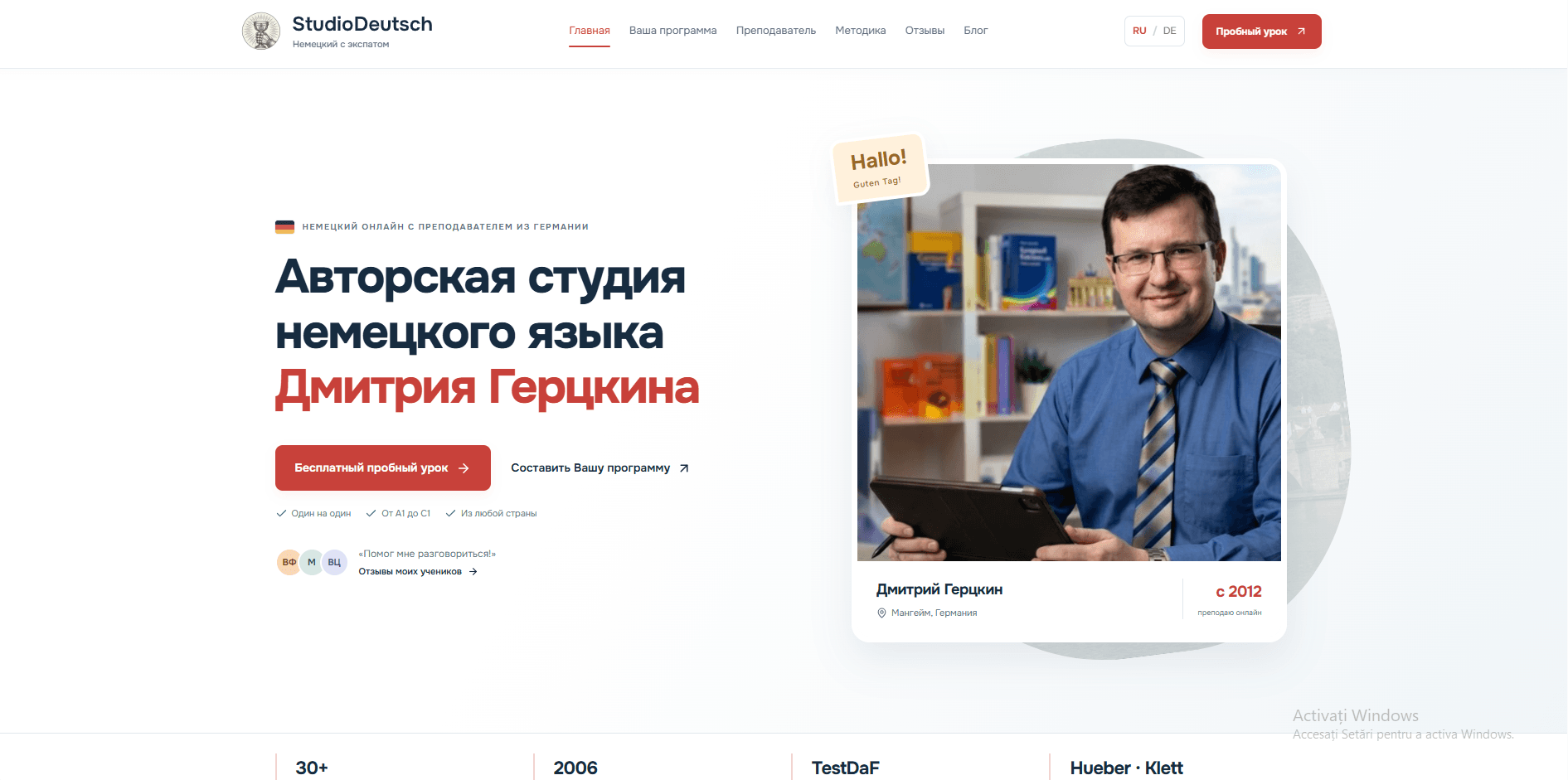
Trust in a project like this begins with the person delivering the lessons. The page introduces Dmitry Gertskin and helps prospective learners discover his experience and approach to explaining the language. The teacher’s photograph has a prominent place on the first screen alongside the main message and trial lesson invitation.
We chose a bright presentation, generous spacing and red accents for the main actions. The visual direction needs to support reading and preserve the studio’s personal character. I like an education website that makes it feel natural to start a conversation with a person. Its design should make that person’s offer easier to understand and help the content hold the visitor’s attention.
Programmes organised around a learner’s goal
People arrive with different needs. Some are starting German, others want greater confidence in conversation or preparation for an examination. The programme structure helps them choose a direction before discussing the details with the teacher. We connect page content with the way someone looks for lessons that suit their situation.
Each programme needs a clear subject, relevant explanations and an appropriate action. A trial lesson button becomes more useful when the visitor understands what they could discuss during that meeting. The website’s structure should therefore follow the real process of choosing a teacher. It helps someone understand the offer gradually instead of presenting a large amount of information without a sensible order or next step.
The trial lesson as the beginning of a conversation
A course website should make first contact straightforward. StudioDeutsch provides access to a trial lesson and a form where someone can give their name, contact, goal and estimated level. Those details help prepare the initial conversation and give the teacher a starting point for understanding the enquiry.
For us, the form’s value lies in connecting the visitor’s intention with the teacher’s work. Someone coming from an exam preparation page should be able to describe that need easily. Someone who does not know their level should be able to say so. A well considered enquiry leaves room for an ordinary conversation rather than making first contact feel like an exhausting questionnaire.
A dedicated administration panel for the client
An important part of the project sits behind the public pages. We built a secure administration panel from scratch so the client can update text and photographs, publish articles and announce events. This is why the project includes working tools as well as the public presentation of the studio.
The teacher needs to keep information current without requesting code changes for every article. Administration should follow their activity: what to publish, where it will appear and what needs reviewing. The public website and internal area have different purposes. Organising them together helps the client continue maintaining the project after its first release, when new subjects emerge and current announcements change.
A mini CRM supports the work after an enquiry
The website attracts attention and receives a request, but the relationship with a prospective learner continues afterwards. We included a mini CRM to organise client information. Its purpose is to give the teacher a working space connected with the activity presented on the website.
I think internal tools should suit the scale of the business. In a personal education project, someone needs to find information and continue a conversation without an interface crowded with unrelated features. We develop administration and the public experience together. That provides a clearer basis for later improvements and keeps discussion focused on working needs rather than adding features simply to lengthen the project description.
The blog and news keep the studio current
The blog gives the teacher room for explanations and experiences that will not fit into a programme description. The news section serves another purpose: announcements, events and studio updates. Separating them helps visitors understand the context and gives the client a suitable place to publish each kind of information.
This work continues after launch. An education website develops through current content, questions and subjects the teacher can explain from experience. We prepare the structure and administration tools, while the studio’s voice should remain the teacher’s. A useful article published in context can help someone understand the offer better than a page created only to add another item to the menu.
Desktop PageSpeed: a performance score of 95
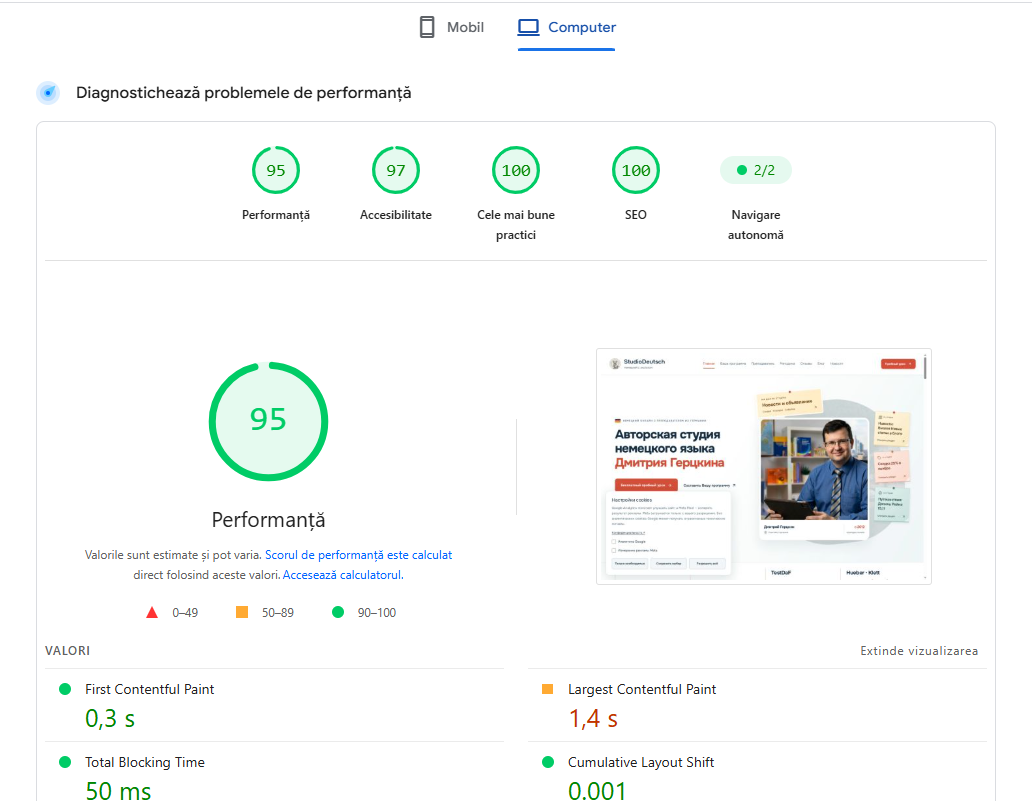
StudioDeutsch · Desktop: performance 95, accessibility 97, best practices 100, SEO 100. FCP 0.3 s · LCP 1.4 s · TBT 50 ms · CLS 0.001. Original supplied screenshot.
Open the screenshot at its original sizeThe desktop capture shows 95/100 for performance, first content in 0.3 seconds, LCP of 1.4 seconds, TBT of 50 ms and CLS of 0.001. Accessibility is 97, while best practices and SEO are 100. We retain the original report so the complete result can be read alongside the explanation.
Technical checks complement the website’s presentation. We want the photograph, information and actions to appear in a comfortable sequence. A laboratory report documents an individual run and helps identify what deserves investigation. Its scores do not measure the number of students or promise a particular Google position. We use the report as technical evidence supporting further work on the page.
Mobile PageSpeed: 74 and a clear LCP priority
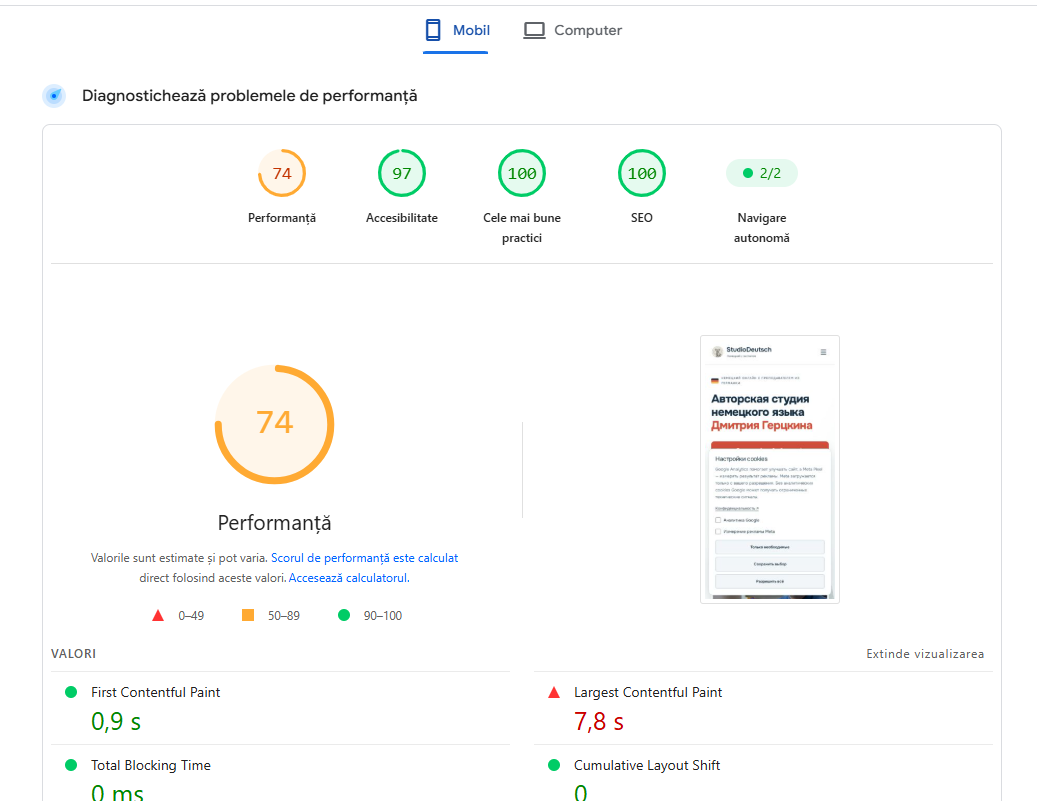
StudioDeutsch · Mobile: performance 74, accessibility 97, best practices 100, SEO 100. FCP 0.9 s · LCP 7.8 s · TBT 0 ms · CLS 0. Original supplied screenshot.
Open the screenshot at its original sizeThe mobile capture shows 74/100, first content in 0.9 seconds, LCP of 7.8 seconds, TBT of 0 ms and CLS of 0. Accessibility remains 97, while best practices and SEO are 100. Loading of the main element is a clear direction for continued optimisation in this report.
We do not determine the cause from the orange circle alone. We need to check which element produces LCP, when its loading begins and what delays it under the test conditions. The preview also includes the cookie panel, but the image alone does not prove it caused the result. We preserve necessary functions and investigate before selecting the technical change.
Advertising preparation starts with the website
The project includes preparation for Google Ads and Facebook Ads. An advert about a particular type of lesson needs a destination that continues the same subject. Programme information, the teacher and first contact should remain consistent with the message that brought the visitor to the website.
This is why we consider structure, content, performance and enquiries as parts of the same project. Commercial results need information about actual requests and what happens after them. The screenshots here provide technical evidence. They do not contain enrolment figures, so we do not turn the scores into unsupported claims about sales or advertising performance. Those questions require their own measurements and context.
A live project that continues to develop
StudioDeutsch brings together the teacher’s identity, information for prospective learners and the client’s administration tools. We continue developing the website around those needs. The PageSpeed reports document the current stage and give us a concrete direction for further mobile work.
Explore the full project in the StudioDeutsch case study. If you are preparing a school, courses or education services, see website development, CRM and administration and performance optimisation, or tell us about your project. We will begin with how you work and the people you want to help learn.
Sources and documentation
Your notes
Notes stay in this browser.