How we redesigned Globaltur and moved the previous website to a subdomain
A complete redesign, Romanian and Russian catalogue, administration and launch on the company domain. Augustin Nicolau explains the Globaltur project with real before-and-after versions.
Augustin NicolauADS Moldova Administrator

Contents
I am Augustin Nicolau, ADS Moldova’s administrator. In this article I explain how our team rebuilt the Globaltur travel agency website. On 17 November 2026, the new version went live on the company’s main domain, while its previous website was preserved on a separate subdomain. The brief went beyond a more attractive homepage: the agency’s information, bilingual catalogue, photographs and access to services needed to survive the transition. Below I describe the design decisions, content management, migration and release checks. The account is based on the project files and launch report, with real pages available for comparison.
Before and after: two versions you can inspect
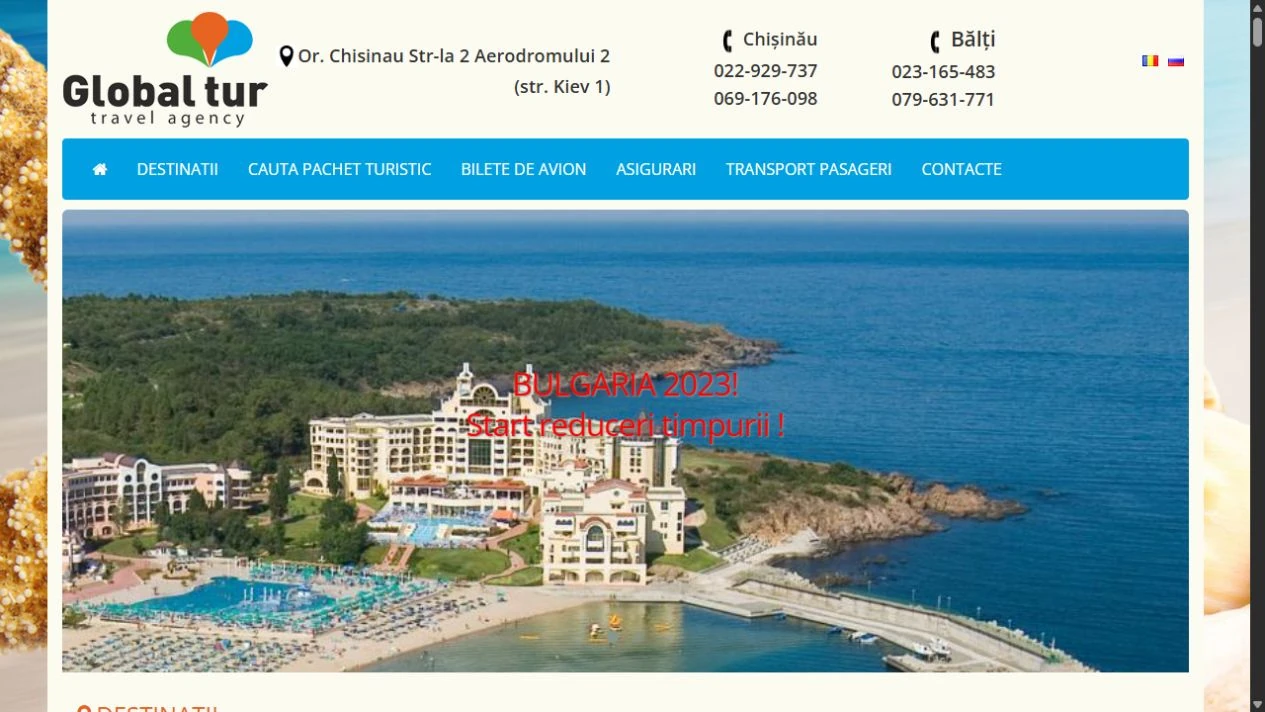
Before redesign. A real capture of the preserved vechi.globaltur.md version, 17 November 2026.
Open the screenshot at its original sizeYou can open the new Globaltur website and the previous version. We kept both addresses so that the change can be assessed directly. The old website shows the starting structure: a horizontal menu, a large carousel, destination lists and many offers displayed together. The new site creates a clearer journey from inspiration and destination choice to a hotel page and an agency enquiry. Readers do not have to rely on a description of the transformation. The screenshots in this article show real pages. The cover is a conceptual redesign illustration, kept separate from visual evidence of the delivered website.
The first step was an inventory of existing content
Before drawing the new interface, we examined the previous website’s pages and resources. For a travel agency, a hotel entry is more than a title and a picture. It may contain a substantial description, a gallery, resort information and a separate offer block. We traced those relationships across Romanian and Russian versions. Available material was recovered and reorganised, while pages or images already missing from the source were documented. We did not replace missing hotel information with invented descriptions. This groundwork made the difference between an attractive demonstration and a reconstruction that could actually carry the agency’s working catalogue into the new website.
A modern design that retains the agency’s identity
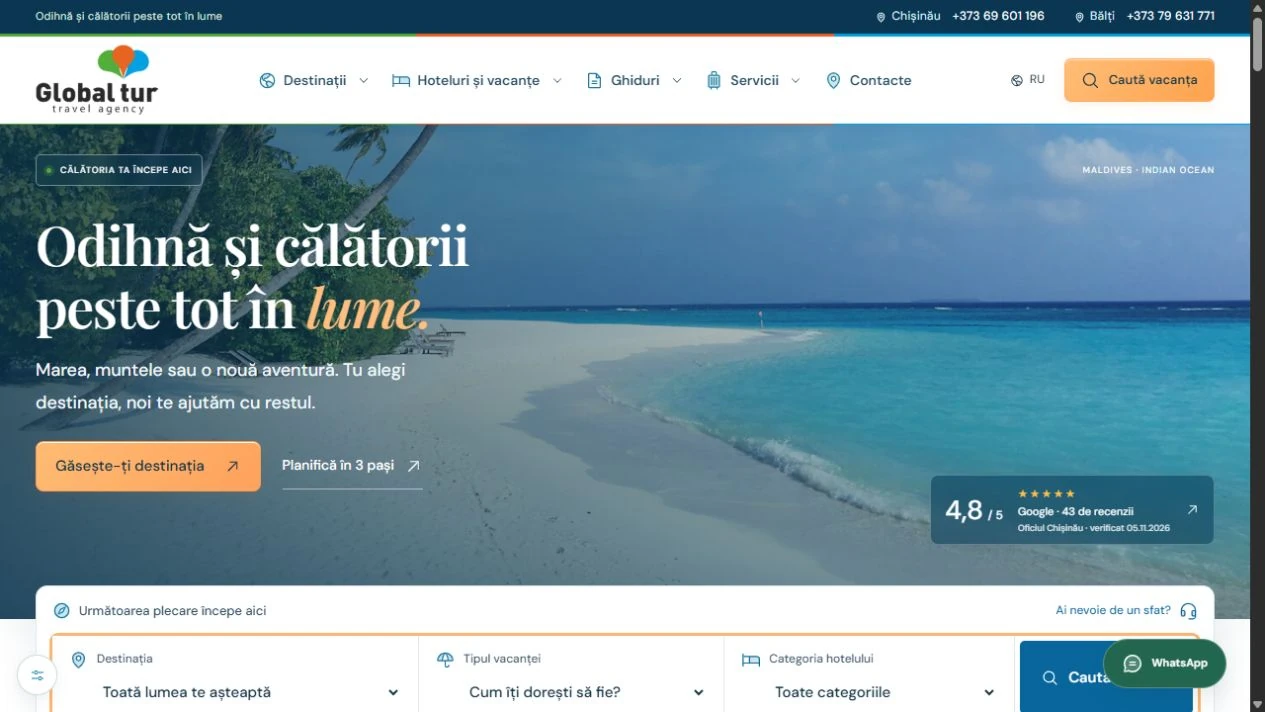
After redesign. A real capture from globaltur.md, the company’s main domain, 17 November 2026.
Open the screenshot at its original sizeThe visual direction starts with travel: full-width hero photography, space between sections, warm accents and a clear reading hierarchy. Globaltur’s logo and identity remained the starting point. Following the client’s feedback, the final typography pairs Playfair Display headings with DM Sans body text and controls. Russian body copy uses Onest for consistent Cyrillic coverage. Fonts are hosted locally. Reading text is 17 px on desktop and 16 px on mobile, with contrast and image framing refined through inspection of real pages. These choices bring visual consistency to the project while keeping the content, agency identity and practical reading experience connected.
Navigation follows the traveller’s questions
One visitor may already know the country they want to visit, while another is still looking for a holiday idea. The final menu therefore groups destinations, hotels and holidays, guides, services and contacts. Holiday search has a separate visible button. Existing flights, insurance and passenger transport options were retained within the new submenus. Countries and resorts keep their relationships with relevant catalogue material. We revised the structure in response to the client’s comments, aiming for a calmer header without losing important agency services. Contact details for both offices remain distinct, helping visitors understand which team and location a telephone number belongs to.
A hotel catalogue visitors can explore
We built catalogue filters for hotel name, destination, holiday type and star category. Results can be sorted, while pagination retains the current search. On mobile, filters open when needed instead of permanently occupying the first screen. A hotel page brings its photographs, description and enquiry route together. The selected hotel is prefilled when the visitor proceeds towards an enquiry. We did not describe the catalogue as an automatic booking engine with live room inventory: the agency confirms prices and availability for the requested travel dates. That distinction matters when historical offers are preserved, because older text must not become an unconditional promise of a current price.
Photography should be useful and accurate
Image handling received its own review. Where a property had photographs in its other language version and the relationship could be verified, we recovered those images. Where no verifiable property photograph existed, a separate destination scene could be used with an explicit illustrative label. It is not presented as a photograph of the hotel and does not inflate the property gallery’s image count. We also corrected card image framing to avoid empty spaces and conflicting proportions. Additional images have responsive WebP versions and documented sources. This approach makes the catalogue visually complete while telling visitors what the imagery does, and does not, represent.
Administration is part of the delivered project
The Globaltur team needed to maintain the website after launch. Its panel supports editing titles, descriptions, body content, offers and photographs, as well as changing cover photos and image order. The client can add destinations, resorts, hotels and articles, or hide pages. Romanian and Russian content is edited separately. Office contact information is managed in settings, with each office’s first mobile number used in the header. The enquiries area retains context submitted through the form. We distinguish these editorial functions from the overall design system: an administration panel does not mean that every detail of every template is exposed as an editable field.
The implementation fits the company’s existing hosting
The published solution was adapted to the existing Amplica hosting. The new website is a working public application with administration and data stored separately from files visitors can access. The objective was continuity for the agency, rather than an infrastructure change for its own sake. Content already in administration, contact details and the domain’s email configuration were preserved at launch. This matters to a business receiving enquiries while its website is being rebuilt. Before switching, we defined which version should answer on each domain, how the testing address should behave and where the previous website would remain accessible after publication.
The migration placed the new website on the main domain
We prepared complete backups of the previous website, the modern version and private data before the switch. The new site now runs on globaltur.md under /rom and /rus, while the original remains at vechi.globaltur.md. The archive has HTTPS and remains navigable. The nou.globaltur.md testing address permanently redirects to the main domain, preserving paths and parameters. Legacy index.php addresses were mapped to corresponding pages, and necessary older resources remained accessible through redirect rules. Backups were verified as part of the release. Preserving files, checking addresses and providing access to the earlier version are all parts of the migration, rather than optional jobs after the visual work is finished.
Technical SEO separates the current website from its archive
Public pages on the main domain use production canonical URLs, Romanian and Russian language alternates, a consistent sitemap and robots.txt. The previous version sends noindex instructions so the archive is not offered as a competing current website. Administration and filtered results have separate indexing rules. The 17 November release report records checks of 1,220 canonical pages for HTTP 200 responses, H1 headings, correct canonical URLs and indexability. Redirects and certificates were also checked. These steps establish technical conditions for crawling; they do not demonstrate that Google has already indexed every page and do not guarantee any particular position in search results.
Mobile screens and contact with the agency
Menus, photographs and representative templates were reviewed in Romanian and Russian on desktop and mobile. The release check included the contact page at 360 px, with no horizontal overflow. Office mobile numbers use direct telephone links, and the enquiry journey retains the chosen hotel or holiday idea. Maps and optional services respect choices made in the cookie interface. These details help visitors understand what happens after pressing a button, which office they are reaching and what information has already been supplied. We did not send fictional enquiries to the agency for demonstration. The verification described here concerns documented pages, navigation routes and technical configuration.
What was delivered and what needs measurement next
The concrete delivery is a modern website on the company’s domain, a preserved bilingual catalogue, client administration and a separately accessible previous version. Those are outcomes we can show today. Effects on organic search, enquiry volume and sales should be evaluated after launch using the agency’s data. As ADS Moldova’s administrator, I prefer to separate verified implementation work from commercial results that still need to be measured. Explore the Globaltur case study and our website migration service. For a similar project, the before-and-after comparison is a useful starting point for discussing content, administration, design and a clear release plan.
Sources and documentation
Your notes
Notes stay in this browser.