Local digital strategy: priorities, budget and clear ownership
Start with business capacity and connect the offer, website, promotion and enquiry handling. A practical approach to priorities, ownership and testing decisions.
Contents
A digital strategy is not a list of every channel where a business could appear. It is a set of choices: whom you serve, what you offer, how people find you and what the team can do after first contact. Without these decisions, tools tend to generate activity without a shared direction.
This guide uses a hypothetical furniture workshop in Moldova. Its design and installation capacity is limited, and its owner wants more suitable enquiries. We do not prescribe a universal budget or promise results. Instead, we build a process that can reveal where the next investment of effort belongs.
Define an operational outcome
“More visibility” is too vague to choose between a new page and an advertising campaign. For the workshop, a working outcome could be enquiries for projects the team can execute. Define suitability through work type, location, timing and the information needed for an initial assessment and a useful conversation.
Establish capacity limits as well. If near-term dates are full, the strategy might seek later projects or an accurately described interest list. Do not advertise unavailable capacity. The digital offer should reflect the company's actual calendar and responsibilities, otherwise additional attention creates customer disappointment and unnecessary pressure on staff.
Inventory what already works
Collect the website, public profiles, project examples and enquiry records. Ask the team how customers hear about the business and where questions repeat. Do not assume the most visible channel is the most useful: referrals, search and existing customers may play different roles that cannot be compared through view counts alone.
Inspect a few recent enquiries without unnecessary personal details. What did the person understand, which information was missing and who replied? This exercise may reveal a handling problem before a promotion problem. If requests disappear after contact, a new campaign can amplify the existing difficulty instead of improving the business outcome.
Write an offer for a specific segment
Custom kitchens and office furniture may need different explanations and materials. Choose a segment the workshop can serve and demonstrate well. Describe customer situations, collaboration conditions and available evidence, avoiding broad claims about superior service that do not help someone understand the actual work being offered.
Check the message with the person discussing projects. If advertising promises an immediate quotation but assessment requires dimensions and a conversation, change the promise. Agreement between marketing and sales reduces misunderstandings. Prepare versions in languages the team can actually answer in, rather than simply the languages from which it hopes to attract traffic.
Give each channel a job
The website explains the offer and keeps materials in a manageable place. Search may meet an already expressed need, while visual content can help people compare styles and projects. These roles do not require starting on every platform simultaneously. Choose a combination the team can maintain and evaluate without constant overload.
Use a simple matrix: channel, customer question, required material and intended next action. If you cannot complete a row, that channel is not prepared yet. A measurement-preparation article and an enquiry page have different jobs even when both concern kitchens. This distinction prevents expecting an immediate sale from every piece of content.
Budget for handling as well as acquisition
The total budget should include materials, implementation, promotion and staff time. A plan allocating everything to advertisements leaves photographs, the page and enquiry handling unsupported. Record initial costs, recurring costs and costs changing with workload so that the actual conditions of the chosen approach remain visible.
Do not start with percentages presented as universal rules. Write the hypothesis being tested and the acceptable loss if it fails. Leave capacity for fixes discovered during the experiment. A bounded trial with a clear question can supply more useful information than a large launch without evaluation criteria or an agreed next decision.
Connect contact with subsequent outcomes
Define contact intention, received enquiry, qualification, quotation and commercial outcome. A WhatsApp click does not confirm a message or contract. GA4 provides recommended events including generate_lead, but the business must agree the operational definition and implement it consistently.
For suitable requests, keep an owner, status and known source within necessary data and applicable consent limits. Do not require dozens of fields without a purpose. A small record updated regularly is more useful than a sophisticated CRM people avoid because it takes time without supporting their customer conversations.
Turn the plan into a short working cycle
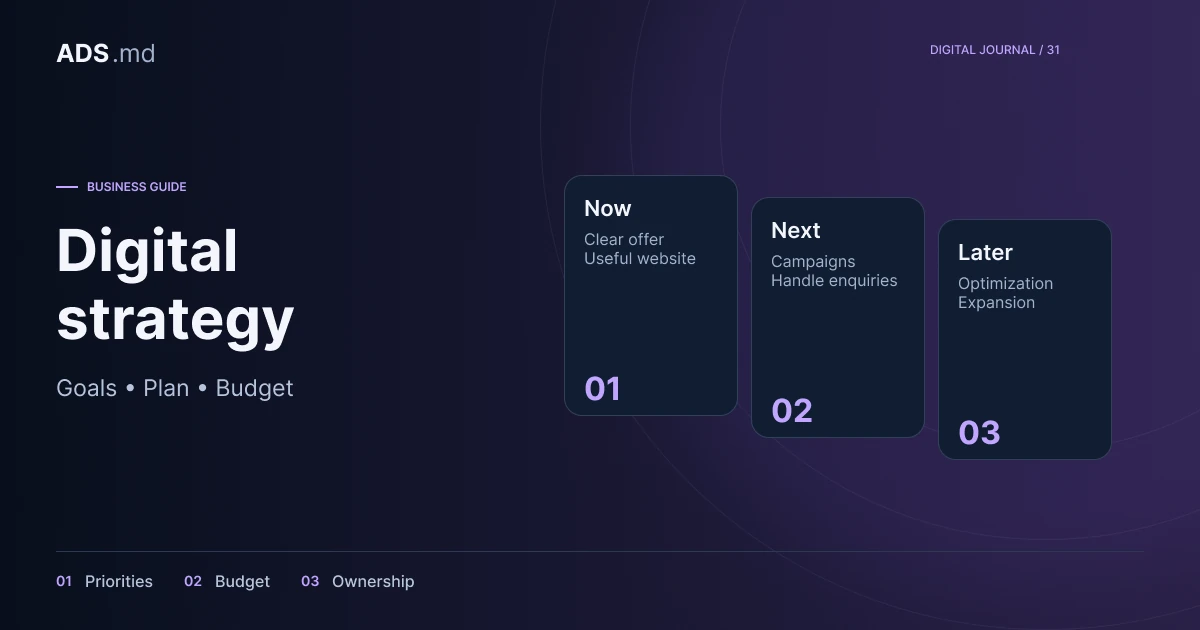
First clarify the offer, prepare materials and remove contact obstacles. Then publish a page and test a suitable channel. Next compare enquiries with real capacity and revise the message. Adapt these stages to the business rather than mechanically following a rigid calendar copied from a template designed for another situation.
For each action, write a short record:
- The specific problem it solves.
- Who executes it and who approves content.
- Information that must be prepared.
- How completion will be checked.
- The decision that observations could support.
Revisit choices alongside figures
During review, discuss what generated suitable enquiries, what consumed unnecessary time and what remains unknown. Compare relevant periods and conditions, including season, prices and availability. Do not attribute every change to one advertisement when the offer, staffing or enquiry process changed at the same time.
In the workshop exercise, the next useful step might be clarifying installation conditions rather than opening another channel. A sound strategy allows that choice. Record the decision and its reason, then update the plan. The website, promotion and enquiry handling can then support the same activity that the company can actually deliver.
Sources and documentation
Your notes
Notes stay in this browser.