Practical retargeting: audiences, messages and verified sales
Build audiences around intent, exclude existing buyers and check what the campaign adds. A practical guide for shops and service businesses with existing traffic.
Contents
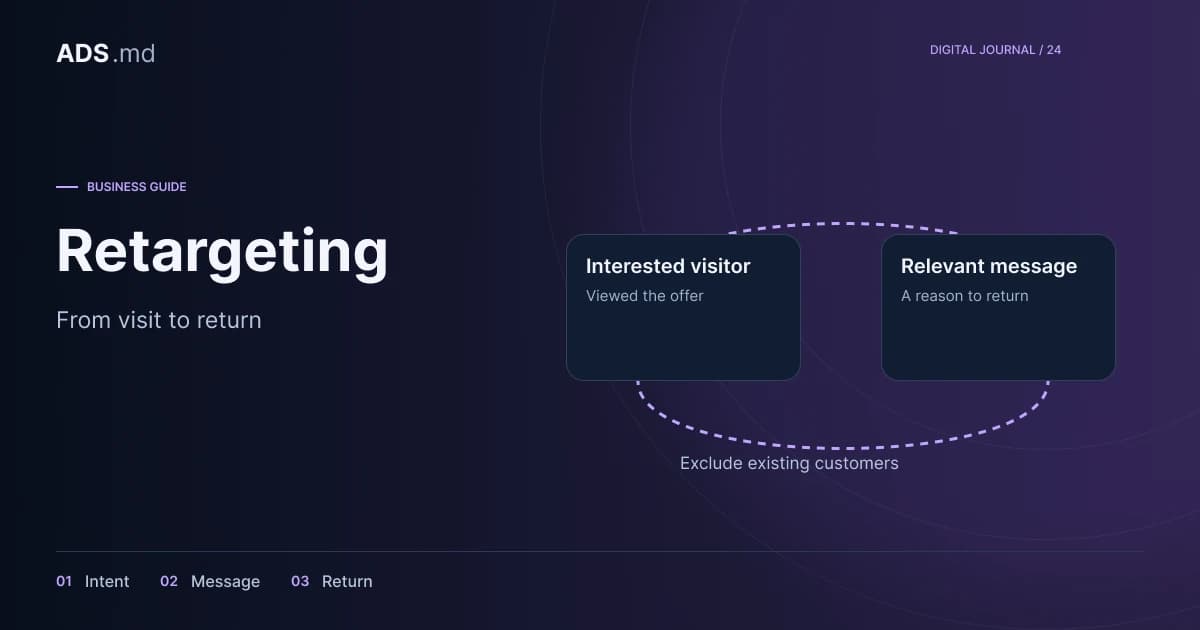
A visitor may leave because they are comparing alternatives, are not ready to buy or could not find an important detail. Retargeting offers another opportunity to explain the offer. It does not automatically fix unclear pricing, a broken form or an unavailable product. Start by identifying why returning would be useful.
Give the return visit a useful purpose
Retargeting and remarketing commonly describe advertising to people who have already interacted with a business. Google Ads presents some of these audiences as segments based on your own data. Terminology and behaviour are covered in Google's audience documentation.
Consider a hypothetical furniture workshop. Looking through a gallery is different from starting an enquiry. The first visitor might need examples and information about materials; the second might be looking for a production timeline. Write down the reason to return before choosing the advertising image.
Check whether the audience can actually serve
Total analytics traffic is not the number of people eligible for personalised advertising. Consent, identifier matching, retention periods and platform rules reduce the available audience. Check the list status inside the account: a correctly configured list can still be too small to serve.
Avoid splitting a few dozen visitors into many groups. Begin with a distinction you can explain and maintain: service visitors and people who started an enquiry. If volume is insufficient, improve relevant traffic acquisition and the page before increasing complexity. Extra segments need a practical purpose, not merely a different name.
Define who enters and who leaves
Each audience needs an entry action, a membership period and an exclusion event. A short window may suit an urgent purchase; a renovation project may need longer. Choose the duration around the decision cycle rather than copying a setting from another campaign.
- Product visitors may need useful details about use.
- Cart starters may need delivery, availability or return information.
- Confirmed enquirers should leave promotion of that same enquiry.
- Existing customers need a genuinely relevant next offer.
Base exclusions on confirmed actions. Clicking WhatsApp does not establish that a message was sent. Pressing a payment button does not establish payment. Excluding on those clicks can remove precisely the visitors who wanted to proceed but encountered a problem.
Let each advertisement answer one question
Develop messages around possible obstacles without claiming to know an individual's reason for leaving. For the workshop, one advertisement could explain measuring appointments while another compares finishes. Avoid intrusive language such as “we know you abandoned the form”.
Send each message to the information supporting it. An advertisement about installation should lead to installation conditions rather than a general page that makes the customer search again. Check the same continuity across Romanian and Russian, including the final button and the form it opens.
Do not treat discounts as the universal answer. They can train customers to wait for offers and consume margin without addressing a lack of trust. Test product explanations, genuine evidence and transparent conditions first. Any promotion should have real, verifiable terms that the sales team can honour.
Carry consent through the whole journey
Nonessential tracking and advertising personalisation require appropriate consent. Connected tools must respect refusal, and withdrawal must stop the relevant subsequent use. A visible banner does not establish that tags, audience lists and data transfers actually follow the person's choice.
Do not send free text from forms, diagnoses, conversations or other sensitive details to advertising platforms. On contact pages, also inspect URLs and parameters that might enter events automatically. Use neutral technical names and only the data needed for the documented purpose.
Watch repetition and audience expansion
A campaign can reach people outside the selected list when its type uses automated expansion or optimised targeting. Check the actual settings before describing its entire result as retargeting. An audience used as a signal is not always a strict delivery restriction.
Watch frequency, spending distribution and reactions alongside confirmed enquiries. Rising frequency in a small audience can signal saturation. There is no universally ideal frequency: an urgent appointment and a made-to-order kitchen have different decision rhythms and need different amounts of explanation.
Separate attribution from additional contribution
A platform may attribute a sale to an advertisement even when that sale would have happened anyway. Its report describes a relationship under an attribution model and window, not proof of individual causality. Compare confirmed revenue with total costs, without adding conversions claimed by several platforms.
In a hypothetical exercise, a campaign reports ten purchases while the shop confirms eight distinct orders after removing duplicates and cancellations. Operational reporting starts with eight. Investigate the difference through identifiers, dates and settings instead of manually adjusting figures to produce a more attractive presentation.
Finish the test with a specific decision
Decide in advance what the test can change: the message, audience duration or budget allocation. Keep conditions reasonably comparable and record promotions, stock shortages and page changes. When volume permits, a control group can help estimate additional contribution, although small local businesses may not collect convincing evidence quickly.
Keep messages that produce suitable enquiries at a sustainable cost, and retire variants that repeat the offer without useful effect. With limited data, “we do not know yet” may be the correct conclusion. The next decision should reduce uncertainty by testing a particular explanation or fixing an observed obstacle, rather than simply increasing the number of advertisements.
Sources and documentation
Your notes
Notes stay in this browser.