IsoTherm Lux: over 1,000 AI impressions in 28 days
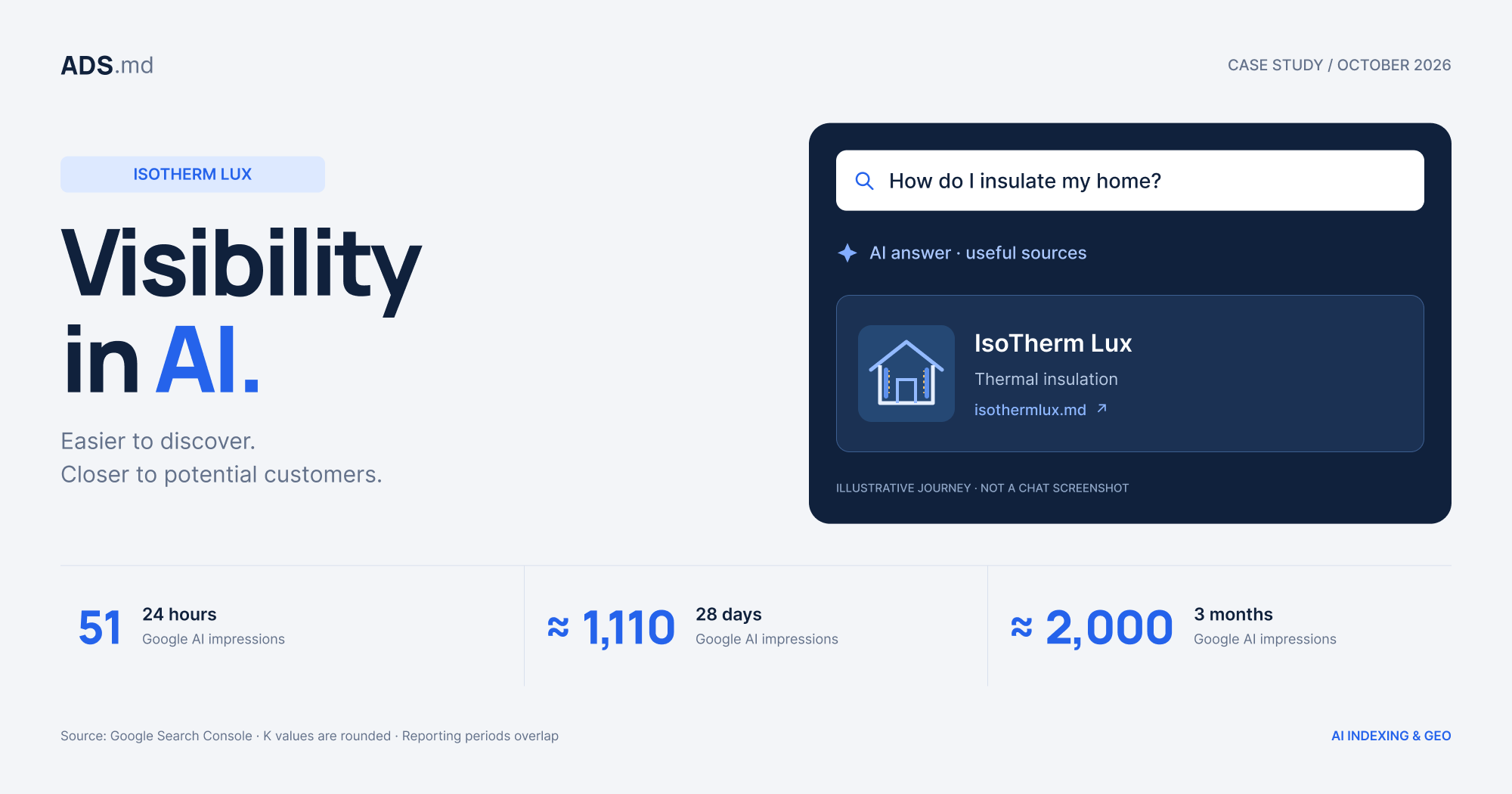
After AI & GEO implementation: 51 impressions in 24 hours, approximately 1,110 in 28 days and 2,000 over 3 months. Augustin Nicolau explains the trend and the journey towards an enquiry.
Augustin NicolauADS Moldova website operator
Contents
51 impressions in 24 hours, approximately 1,110 in 28 days and 2,000 over 3 months. These are the figures shown in the Google Search Console screenshots for isothermlux.md after implementation of our AI & GEO service. The three-month chart also shows something I find more useful than a total: the website appears more frequently in the recent part of the period than at the beginning.
I am Augustin Nicolau, the operator of ADS Moldova. This article follows a real client's visibility and explains why it matters for an insulation business. I have included all three original screenshots so you can see the evidence alongside the explanation, then understand how this kind of discovery can lead someone towards a service page and an enquiry.
The figures we see for IsoTherm Lux
The selected 28-day report displays 1.11 K, meaning approximately 1,110 appearances of the website's pages within Google's generative AI features. The 24-hour screenshot shows 51 impressions, while the three-month view displays 2 K, or roughly 2,000. For a local service business, this is a presence worth understanding and developing further.
I read the figures in the context of the project: a website covering thermal insulation, waterproofing and sound insulation, with service explanations, examples and an assessment enquiry route. It is more than a page containing a phone number. A relevant appearance can become an opportunity for someone researching a building problem to discover the company and continue learning on its website.
Case study · IsoTherm Lux
More visibility in AI. A new route to customers.
After AI & GEO implementation on isothermlux.md, Google Search Console documents a stronger presence in generative AI features. The 3-month chart makes the trend easy to see.
- 24 hours
- 51
- Google AI impressions
- 28 days
- ≈1,110
- Google AI impressions
- 3 months
- ≈2,000
- Google AI impressions
Original screenshots · Google Search Console · published 21 October 2026
How a potential customer can reach the business
A question about home insulation can lead to an AI answer with sources, then to a service page and an assessment enquiry. AI & GEO preparation supports discovery and understanding; the website continues the journey with explanations, project examples and contact options.
The screenshots document Google AI impressions. Visits, enquiries and referrals from other AI chats are measured separately. K values are rounded and the reporting periods overlap.
The chart shows a higher recent level
The three-month view is the most interesting screenshot to me. Many daily values remain near the lower part of the chart earlier in the period. Later, stronger rises appear and more days sit at a higher level. There are fluctuations, but the difference between the beginning and the recent portion is visible without a complicated explanation.
That is what we want to follow after implementation: a presence that repeats, alongside the individual peaks. The screenshots do not provide two equivalent before-and-after periods tied to an exact implementation date, so we do not publish a growth percentage. They do show a clear evolution in recorded impressions. I would rather present that change directly through the report and build on genuine information than attach an unsupported percentage to it.
Why AI visibility matters for an insulation company
Someone interested in insulation does not always begin with a company name. They might start with heat escaping through a roof, condensation, uncertainty about a material or a question about water infiltration. Their first question concerns the building. Comparing contractors and requesting an assessment can come later, after they understand their options better.
AI answers can feature during that research stage. If a website contains useful explanations and can be discovered, it creates another route by which the business might enter a future customer's consideration. For IsoTherm Lux, the practical aim is to be findable around questions relevant to its work. It connects a property owner's need with information that the company can usefully provide, before the person is ready to describe a specific project.
How someone can move from an AI answer to the website
The journey can be straightforward. A person asks what to check before insulating a roof. An answer provides an explanation and sources. They open a page for more detail and discover a business offering the relevant service. They might then view completed work, use an indicative calculator or request an assessment. This is an illustrative journey, rather than a conversation attributed to a particular customer.
For us, AI & GEO preparation should support the complete path. An appearance becomes more useful when the destination page continues the explanation properly. Clear information, suitable examples and accessible contact options give the business a better opportunity to turn interest into a conversation. Discovery and the experience on the website need to be developed together, because the source of a visit does not remove the visitor's need for a useful page.
What we aim to achieve through implementation
In the IsoTherm Lux project, AI & GEO complements website development and SEO. We want important pages to be accessible, focused on a clear subject and consistent in their presentation of the company's services. Technical checks and content organisation address the same practical need: helping a person or system reading a page understand the offer.
In this type of implementation, we examine access to public pages, indexing, the sitemap, canonical addresses, company information and connections between services. We then review explanations, questions and examples. We do not present one file or setting as a command that forces an AI system to recommend a business. The work creates a technical and editorial foundation that can be checked and improved as the project develops.
Useful information starts with customer questions
A general company description cannot answer every insulation question. A property owner wants to understand the surfaces involved, the information needed for a quotation and why the solution depends on the building's situation. A useful page should help them describe their requirements more clearly without implying that every problem has the same answer.
That is why services should connect to explanations and relevant work examples. Someone reading about waterproofing should have a sensible next step towards a related example and a way to contact the team. When preparing content, I think about questions a person would ask in an ordinary conversation. The aim is to answer those questions well and provide enough context for the next decision, rather than collecting impressive technical expressions that mean little to a prospective customer.
The website must be ready for the resulting visit
On isothermlux.md, service pages, the portfolio, indicative calculator and enquiry form each have a different role. Together they can help someone move from a general question to a description of their own work. People arriving from an AI source need the same clarity as visitors coming from search, advertising or a recommendation.
I do not want to bring someone to a website and then leave them searching for essential information. Contact details should be easy to reach on a phone, the service should be understandable and an enquiry should reach the team. The CRM integration described in the project case study supports receiving and following those enquiries. This is where visibility connects to the company's actual work, beyond the appearance of a line on an analytics chart.
What the screenshots show and what we track separately
All three images come from Google Search Console's generative AI features report. They document Google AI impressions, rather than website visits or signed contracts. Google describes the report as a view of page appearances in its AI experiences. K values are rounded and the reporting periods overlap, so they do not form three independent totals to add together.
Visits and enquiries from ChatGPT, Perplexity and other chats need separate verification through analytics and enquiry sources. ChatGPT Search can provide links to sources, but these screenshots do not report its recommendations. Both sides matter to me: documenting the visibility we can see and recognising the visits that continue towards an actual enquiry. They answer different questions within the same customer journey.
How we continue after these results
First, we keep information current. Services, work examples and contacts should reflect what the team can actually offer. We then follow which pages appear and what people ask the business. If a subject keeps returning, it may deserve a clearer explanation, a better page or a new example from the team's work.
It is equally useful to compare similar reporting periods instead of choosing only the day with the largest figure. For IsoTherm Lux, these screenshots provide a documented point in the project's development. Later observations become more useful when measurement stays consistent and interest can be connected with enquiries actually received. That gives us a more practical basis for deciding what to improve next than judging progress entirely by the impression made by a graph.
AI & GEO now starts from 150 euros
We have updated the starting price of AI Indexing & GEO to €150. AI Start addresses the technical foundation: an initial audit, access and indexing checks, robots.txt, sitemap, canonical addresses, blocked or noindex pages, an optional llms.txt directory and a final report. More extensive packages add structural and content work according to the website's needs.
For Google, there is no special file that secures an AI appearance; its official guidance centres on useful content and a sound technical foundation. We begin with the actual condition of the website and agree the necessary work. The price covers implementation within the displayed package, while results are followed for each business individually. This keeps the scope understandable before work begins.
What this case means for your business
For me, IsoTherm Lux demonstrates why AI visibility deserves attention within ongoing website development. Following implementation, we have a report with more than one thousand impressions across 28 days and a stronger recent chart. That is the result we can show now. The next task is to make sure people's interest meets useful pages and a team ready to respond.
We have also updated the IsoTherm Lux case study, alongside its advertising results and website presentation. For a similar project, start with the AI & GEO service page or send us your website. We will review it and discuss what would make sense to implement for your particular business, connecting discovery, information and the route to an enquiry.
Sources and documentation
Your notes
Notes stay in this browser.