AI Indexing & GEO: business benefits and how we implement it
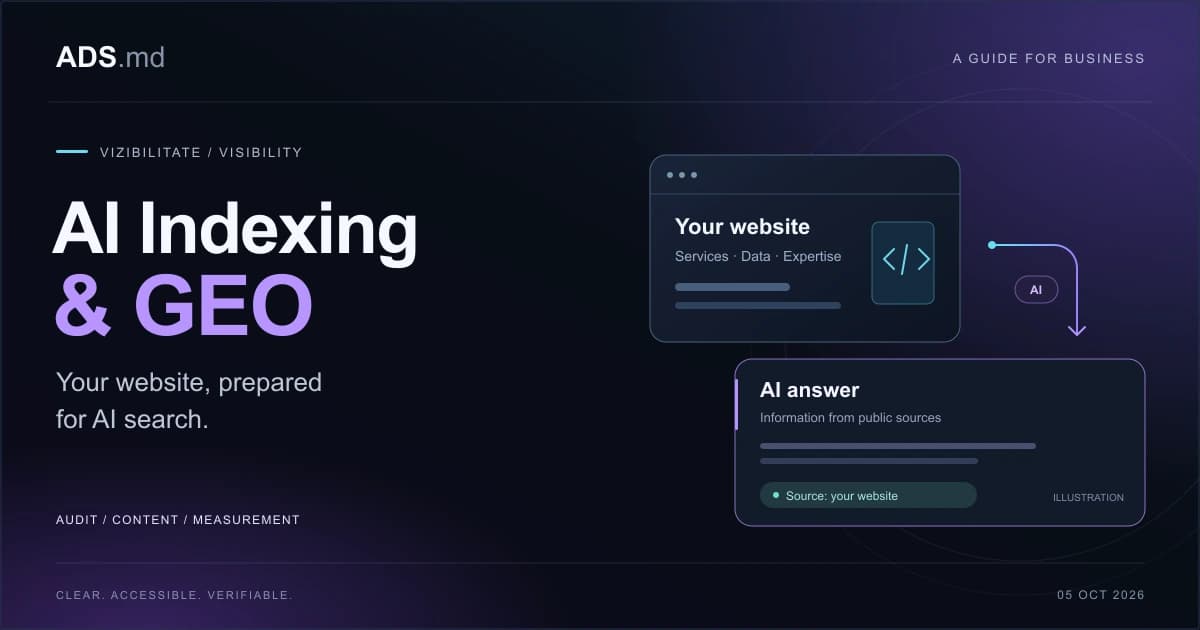
How we prepare websites for AI search: audits, content, structured data and measurement. Practical examples and ADS Moldova packages from €100.
Contents
Case study · adsmoldova.md
257 AI search impressions. In 28 days.
Our website’s visibility in Google Search generative AI features, documented in Search Console.
- 24 hours
- 9
- impressions
- 7 days
- 65
- impressions
- 28 days
- 257
- impressions
Original screenshots · Google Search Console · published 13 October 2026
Impressions measure exposure in Google AI, not visits, customers or ChatGPT recommendations. These periods overlap and must not be added together. One website’s results do not guarantee the same figures for another.
Read the case studyDocumented results on adsmoldova.md
Update dated 13 October 2026: the Google Search Console screenshots in this article’s gallery show 257 generative AI feature impressions in 28 days, 65 in 7 days and 9 in 24 hours. These are Google Search impressions, not visits or confirmed ChatGPT recommendations. The periods overlap. Read the case study and interpretation.
Someone asks an AI assistant which company offers a service in Chișinău, how two solutions compare, or what to check before requesting a quotation. For your business, the practical question is whether your website contains clear, accessible information that a search system can discover and use.
The AI Indexing & GEO service from ADS Moldova starts with that foundation. We examine technical access, organise information about the company and prepare important pages for discovery, understanding and potential citation. Our work concerns the website and public sources we can verify. The AI platform still decides which sources it uses in a response.
What AI Indexing & GEO means
GEO stands for Generative Engine Optimization: preparing content for search experiences that generate answers. In our offer, AI indexing describes technical and editorial work. There is no universal registration form that places a company in ChatGPT, Gemini, Copilot and every other platform at once.
Three stages matter: a page can be accessible, a search engine can process it, and a system can select it as a source for a particular answer. Completing the first stage does not guarantee the other two. Our deliverables are therefore verifiable changes and a clear report, rather than a promise of a first position in AI.
GEO complements local SEO. Google's AI Overviews and AI Mode rely on the existing SEO foundation, without special additional technical requirements. Eligibility requires indexing and permission to display a Search snippet; inclusion is not guaranteed. These Google Search features should not be equated with every experience in the Gemini app. See Google's documentation.
How this can help a business
The first benefit is a clearer offer. A visually attractive website may still fail to explain where the company works, what a service includes or how a price is calculated. Organising that information helps people compare suppliers and gives systems consulting the web more precise source material. Visibility is useful when visitors arrive at an offer they can understand.
The second benefit is fewer contradictions. An outdated telephone number, inconsistent business names or discontinued services create confusion. We review important information with the team and establish which page represents the current source. This also helps employees answer enquiries and prepare quotations without relying on several conflicting versions of the offer.
The third benefit is a reusable content foundation. A well-explained service can support organic discovery, paid advertising and a sales conversation. A documented case study communicates experience more effectively than another collection of slogans. We do not attribute all these improvements exclusively to AI: a clearer website can help throughout the journey from research to contact.
A practical example: turn a general introduction into a useful answer
Imagine a cleaning business whose homepage only promises professional services and attractive prices. A potential customer wants to know whether it handles cleaning after renovation, which surfaces it accepts, whether supplies are included and what determines the quotation. Generic promotional wording does not help that person decide whether to enquire.
In a proposed structure, we separate regular cleaning from post-construction cleaning. Each page explains included tasks, exclusions, service areas and the information needed for an estimate. We add questions the team actually receives and authentic photographs where usage rights exist. If timing depends on floor area and the condition of the property, we explain those dependencies directly.
The page can then answer a specific question without requiring readers to search the entire website. This is an implementation example, not a measured customer result. A window supplier could use the same approach for materials, installation and warranty. An online store could clarify delivery, availability and returns. A B2B provider could explain stages, responsibilities and quotation criteria.
How ADS Moldova implements the service
ADS Moldova is a digital services platform. We can connect indexing work with website development, content, measurement and other services a project needs. We begin with the commercial objective and the pages supporting it. The exact interventions depend on the selected package, the website's condition and the access available.
1. Establish what the customer needs to understand
We discuss priority services, service areas, audience languages and questions people ask before ordering. We request confirmed company information and identify who will approve commercial details. We select pages with a clear role in the sales process rather than automatically rewriting every existing URL.
For a business in Moldova, Romanian and Russian versions should describe the same offer. English can be appropriate for an international audience. Translation must not introduce different prices, timelines or promises. The initial question list becomes an editorial reference for implementation and the subsequent review, helping the team focus on information that supports actual decisions.
2. Audit access and indexability
We examine public pages, server responses, redirects, noindex directives, robots.txt and canonical URLs. We check whether the main information is available in HTML and whether navigation leads to important pages. Confirmed issues are recorded separately from questions requiring administrative access or clarification from the existing developer.
A sitemap helps search systems discover URLs; it does not confirm that every page has been indexed. We remove unsuitable entries and check consistency with the public pages. Google's sitemap guide explains its purpose and limitations. The audit produces a prioritised work list: blockers, necessary corrections and subsequent improvements.
3. Configure relevant crawler access
We check both website rules and possible restrictions at the hosting or CDN layer. Private areas remain protected; changes concern the agreed public content. Editing robots.txt alone will not resolve a security challenge that prevents the requested page from loading.
OpenAI's OAI-SearchBot serves search, while GPTBot concerns content that may be used for training. Their controls are independent: allowing search does not require allowing training. We apply the agreed preference using the official crawler documentation. A crawler visit is not proof that the business is already being recommended.
4. Clarify company identity and structured data
We review the business name, contact information, service area and links to official profiles. Where included in the package, we implement appropriate Schema types, such as Organization, LocalBusiness or Service, according to the actual page. We do not add imaginary offices, reviews or accreditations to make the business appear more established.
Structured data must describe visible, current information; correct markup does not guarantee a special search appearance. We follow Google's structured data guidelines. For multilingual websites, we also check the relationships between versions so that language, offer and page addresses remain consistent.
5. Organise pages around real questions
We clarify vague headings, separate subjects and provide direct answers before detailed explanations. Conditions that belong together stay together: what the service includes, what is quoted separately and which details are needed to prepare an offer. Repeating an AI-related keyword across a page is not a substitute for useful information.
We draw on real company experience: processes, examples, materials, photographs and documented outcomes when available. For a new page, we can propose a case study structure without inventing results. Frequently asked questions should resolve customer decisions, rather than becoming an artificial keyword collection unrelated to conversations the team actually has.
6. Prepare notifications and supporting documentation
Where included, we implement IndexNow to notify participating search engines about changed URLs. The IndexNow FAQ states that notification does not guarantee indexing. We check notification acceptance separately from subsequent search engine outcomes.
The offer also includes an llms.txt file as an additional editorial map of useful pages. We treat it as supporting documentation without promising that every platform will read it. Accessible public content remains the foundation. This file does not replace pages, access rules or verification, and it is not guaranteed registration with an assistant.
7. Test and hand over the work
After implementation, we check changed pages, internal links, public access, languages and the agreed technical elements. The report distinguishes what we found, what we corrected, what remains dependent on other teams and what we recommend next. The client can review specific interventions rather than a list of unexplained technical terms.
We also establish responsibility for updates. Changes to prices, telephone numbers or delivery areas need to reach the relevant sources. Even a sound implementation loses value when the website continues describing an old offer. Support and subsequent checks follow the selected package, while ongoing content ownership needs to remain clear within the company.
Which package may fit your website
On the publication date, 5 October 2026, the service page presents three packages. Selection should follow the issues found, not simply the total number of pages on the website.
- AI Start — €150: initial audit, indexing and crawler checks, robots.txt, sitemap, llms.txt, canonical and blocked-page checks, a final report and seven days of support. This provides the technical foundation for a small website needing attention.
- AI Growth — €200: includes AI Start, IndexNow, Search Console and Bing Webmaster Tools configuration where access is available, Schema, hreflang and local-information checks, answer structure and optimisation of up to five important pages. GEO recommendations and 14 days of support are included.
- AI Authority — €300: includes AI Growth, optimisation of up to ten important pages, a digital identity audit, local-information review, internal links, a case study structure, two complete article proposals and AI referral monitoring in GA4 where possible. It includes a post-implementation check, a report after 30 days and 30 days of support.
Authority's ten-page limit is the package total, not ten additional pages on top of Growth. Article proposals do not automatically mean two published articles. Larger rebuilds or additional functionality require a separately agreed scope, cost and level of access before implementation.
Measuring progress without misleading numbers
We separate technical implementation, observable visibility and commercial impact. First, we confirm corrections. Then we review discovered pages and available signals from configured tools. Commercially, relevant visits, completed forms and enquiries that could become customers matter more than the activity of an automated crawler.
The AI Performance report in Bing Webmaster Tools reports citations across supported Microsoft and partner experiences. Citations are neither rankings nor sales, and this report does not cover every AI platform. We use it within the scope it actually measures.
In GA4, where source identification is possible, we can observe visits arriving from certain AI platforms. A mention without a click does not automatically create a measurable visit. We compare periods and record changes without attributing every increase to one intervention. Manual checks using predefined questions remain individual observations rather than a stable ranking system.
What to prepare before we start
Send your website address, priority services, target markets and languages. Current commercial details and questions received from customers are useful. A public audit can begin without full access; implementation requires appropriate permissions or cooperation with the existing administrator. Passwords and access keys do not belong in public forms or website content.
Explain what counts as a relevant enquiry. A company seeking recurring contracts has different priority pages from a store selling seasonal products. This helps the implementation plan reflect the real business and makes its usefulness easier for the team to evaluate.
AI Indexing & GEO prepares a clearer, more accessible and verifiable digital presence. To understand what may be preventing your website from being discovered today, review the service and available packages or send us your project for assessment. We start with the existing situation and agree on the work that deserves attention first.
Sources and documentation
Your notes
Notes stay in this browser.