Facebook and Instagram ads: prepare the offer, creative and response
Plan a local campaign from its opening frame to the received enquiry. Choose the message, prepare creative and compare results in the context of your offer.
Contents
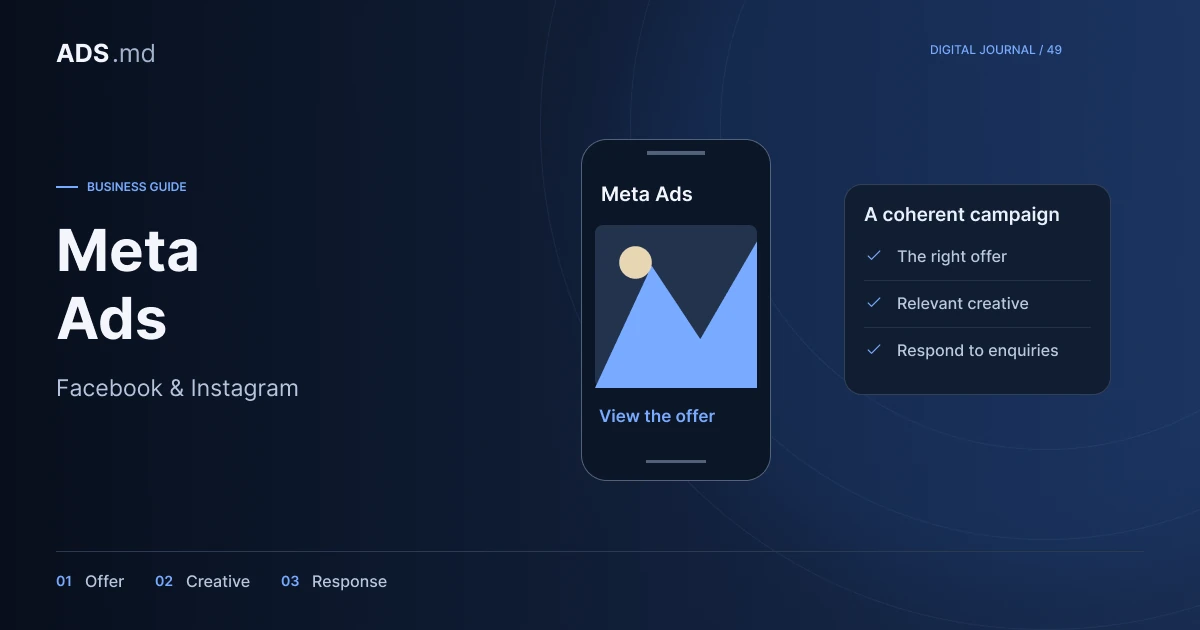
On Facebook and Instagram, advertisements appear in a feed where somebody may not be actively seeking your service. The material needs to provide a reason to pay attention, and the page or conversation must continue the same idea. Campaign preparation therefore connects the offer, creative and the team’s response capacity.
Consider a fictional furniture workshop seeking discussions about custom kitchens. The scenario shows how to organize a local campaign and what to check after launch. Budgets and outcomes depend on the business context rather than universal figures.
Express the offer as a next step
Describe what somebody receives after responding. For the workshop, this might be a project discussion based on dimensions and location. Explain the next step and who handles it so interest created by an image has a concrete continuation.
Collect differences you can demonstrate: finishes, space organization or the measurement process. Choose one starting point for each creative. A photograph with a precise explanation may be easier to understand than a list of every service and advantage the company offers.
Identify the enquiries the business can support. Coverage, project types and availability influence the message. Present important conditions early enough for people to assess suitability and decide whether discussing their own project is worthwhile.
Choose the result and destination together
Decide whether you need visits for research, completed forms or conversations. In the advertising account, select the objective and result destination matching that step after checking available options. Evaluate the campaign through the action it was designed to produce.
Your own page allows work and conditions to be presented before contact. An in-platform form may shorten completion, while a conversation can suit projects that vary substantially. Choose according to the information needed and how staff handle enquiries.
For our workshop, a form might request location and approximate dimensions. If those details are difficult to provide immediately, allow an introductory discussion. The journey should help customers express their needs while giving staff enough context for a useful response.
Build the creative around a real example
Choose work you have permission to present and explain what viewers see. A wide shot can show the room, while a detail explains one solution. Connect the material to the company’s actual contribution and a service available under the stated conditions.
For video, begin with information that helps people recognize the offer. Show the product or situation and use readable wording. A storage explanation might lead to a drawer detail and then an invitation to discuss the viewer’s own kitchen.
Prepare variants with distinct ideas: completed work, the production process and an answer to a recurring question. That comparison helps identify reasons for response. Changing only a button colour reveals less about what the audience values in the offer.
Adapt each asset to its placement
Meta presents Reels advertising for Facebook and Instagram. Prepare those assets in the context of phone viewing and inspect actual account previews before activating the selected placements.
Keep the main information visible alongside the account name, description and platform controls. Check subtitle and price legibility. A feed placement may need different framing even when the underlying idea, source images and offer stay the same.
Review the advertisement with and without sound. Voice adds personality while text should retain the main meaning. For music or third-party imagery, confirm advertising rights specifically; availability for an ordinary social post may involve different conditions.
Organize audiences around actual coverage
Define service areas and languages in which staff can continue the conversation. Review account settings and any available audience expansion. Local businesses need enquiries they can fulfil, so geographic decisions should reflect actual delivery or travel capability.
Keep the test structure proportionate to the available budget. Too many groups and variants divide observations into fragments that are difficult to compare. Start with important audience or offer differences and record which question each comparison is intended to answer.
Prepare response and enquiry qualification
Before launch, assign an owner and response schedule. Prepare an introduction that recognizes the advertised offer and requests the necessary clarification. For the workshop, this could mean room type and project stage rather than repeating the general service catalogue.
WhatsApp Business Platform provides messaging integration possibilities. Choosing automation is separate from providing a simple application contact link. In either case, preserve a clear route to somebody who can confirm working conditions and next steps.
Record whether an enquiry is suitable and why the conversation ends. This information helps interpret the campaign. A completed form may start a project or contain a preliminary question; staff records provide context beyond a raw submission count.
Track sources and results separately
Use a naming convention for campaign links; UTM parameters can help identify visits. Verify destinations, redirects and relevant events. Keep clicks, received enquiries and confirmed commercial outcomes separate to understand the journey accurately.
When measuring in both browser and server, check duplicates and consent behaviour. Compare platform reporting with enquiry records while accounting for different attribution windows and methods. Differences need investigation rather than manual adjustment of totals to make dashboards match.
Choose the next change from observations
When creative attracts attention but enquiries are unsuitable, revisit the offer and qualifying information. When useful requests go unanswered, improve intake. A recurring question identifies an explanation that belongs in the advertisement or destination page.
Keep a change record and compare periods appropriate to the business’s operating rhythm. Expand what generates suitable requests and can be supported by staff. Campaign value comes from continuity between the material, the expectation it creates and the actual conversation with the company.
Sources and documentation
Your notes
Notes stay in this browser.