CursuriOnline.md: ADS Moldova’s practical learning project
Why we created CursuriOnline.md, the need it addresses in Moldova and how it connects six course directions, individual mentoring and practical projects.
Contents
CursuriOnline.md is a new educational project created and managed by ADS Moldova. It brings together six learning directions: websites, online stores, Shopify & Etsy, Meta Ads, Google Ads and Claude & Codex AI. Individual mentoring provides another way to work towards a specific goal. The idea behind the platform is straightforward: digital knowledge becomes useful when you can turn it into a project that you can build, check and explain.
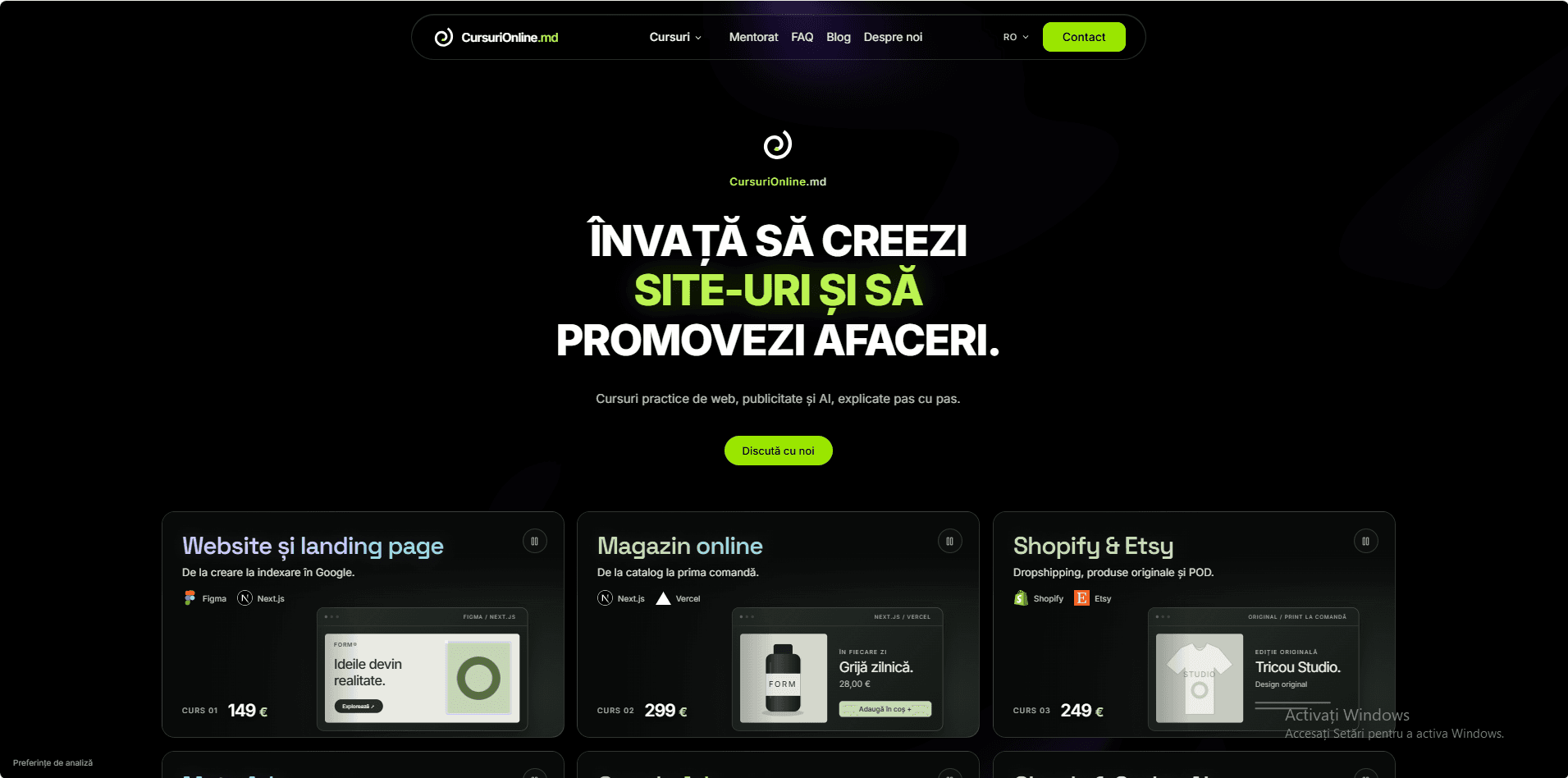
This article introduces the reasons for creating the project, the structure of its website and the needs it aims to address for people in Moldova. It describes the product and its direction, rather than reporting student earnings. CursuriOnline.md is already public and development continues. The screenshot below shows the interface of the project now featured in the ADS Moldova portfolio.
From separate tutorials to a working process
Someone preparing to build a first website can quickly find explanations of design, domains, forms and advertising. The difficult questions often fall between those explanations. What comes first? How does the offer connect to the page? What needs checking before publication? A tutorial may demonstrate a button in detail without explaining what information should reach the person responsible for answering an enquiry.
CursuriOnline.md starts with the difference between watching a demonstration and being able to repeat a process independently. The proposed approach connects the objective, requirements, implementation and verification. An exercise should produce something concrete: a published page, an organised catalogue, a test order or a campaign prepared for review. Progress can then be discussed through actual work, including the decisions behind it, rather than only through the number of lessons completed.
The need we aim to address in Moldova
For a local business owner, digital work involves connected decisions. Which languages should explain the offer? How will enquiries arrive? What information is missing before an estimate can be prepared? Who responds after the first message? Choosing an application addresses only one part of the problem. The rest depends on understanding the business and presenting its activities clearly online.
The project is intended for beginners, freelancers, creators and people already working inside a business who want greater independence. We do not assume that every company in Moldova faces the same difficulty. We focus on people who can access tools and information but still need a sequence, practical work and feedback. The aim is to help them handle basic tasks and work more effectively with specialists when a project needs additional expertise.
An owned project with clear responsibility
CursuriOnline.md is created and managed by ADS Moldova alongside AI Moldova, Bonusuri.md and MDStore.md. Each project has a different purpose. AI Moldova focuses on AI tools, MDStore on art and local creative products, and Bonusuri on tasks and user interaction. CursuriOnline.md adds an educational direction: explaining and practising the skills involved in building digital products. It has its own audience and its own offer.
The relationship with the agency is explained in the project presentation and on the About ADS Moldova page. Courses and agency services nevertheless serve different needs. A course helps someone learn to do the work; a website development service defines a result delivered for a business. Keeping that distinction clear helps visitors choose suitable support without confusing course enrolment with commissioning a complete website or ongoing campaign management.
Six directions organised around an outcome
The catalogue does not begin with an endless list of applications. Its six directions correspond to different outcomes: a presentation page, an online store, a commerce model, promotion through Meta, promotion through Google and development assisted by AI. Each course card provides a title, a short description, relevant tools and a route to the course programme. Visitors can understand the purpose before examining the detail.
The appropriate order depends on the objective. Someone whose offer is not yet clear may benefit from building a page before paying for traffic. An existing store owner may need to understand campaigns or measurement instead. The course catalogue supports comparison, while the enrolment conversation clarifies the starting level. There is no need to begin every course simultaneously to create a first useful project. A relevant next step is more valuable than an oversized list of tools.
Websites and stores provide the foundation
The Website and landing page direction connects the structure of an offer with design and implementation. A service page needs to explain its audience, what is provided, the visitor’s likely questions and the next action. Tools such as Figma and Next.js are presented in relation to that outcome. Preparation for indexing forms part of the learning direction, although publishing a page does not automatically guarantee a search position.
An online store introduces further relationships: product, category, cart and order. An attractive illustration does not replace product information or confirmation that an action succeeded. Exercises can examine how an item is found, what the customer sees and what information reaches the store team. Understanding the difference between a store and a presentation website before choosing a solution helps design support the actual activity of the business.
Commerce, advertising and AI in practical context
Shopify & Etsy addresses another decision: where and how an offer is presented. The programme introduces subjects such as original products, dropshipping and print on demand. Platform selection should reflect the product, account conditions and applicable costs. Including a platform in the catalogue does not mean that every sales model automatically suits every participant. The useful learning task is to understand the available options before committing to a particular approach.
Meta Ads and Google Ads examine two promotional contexts: messages with creative materials, and the intention expressed by a person searching. In both cases, the destination page and measurement connect directly to the campaign. Claude & Codex AI adds assisted work on digital products. The emphasis is on defining requirements, checking the output and understanding changes. Generating code remains one part of a controlled process in which the person doing the work can explain and verify the result.
Visual identity supports navigation and choice
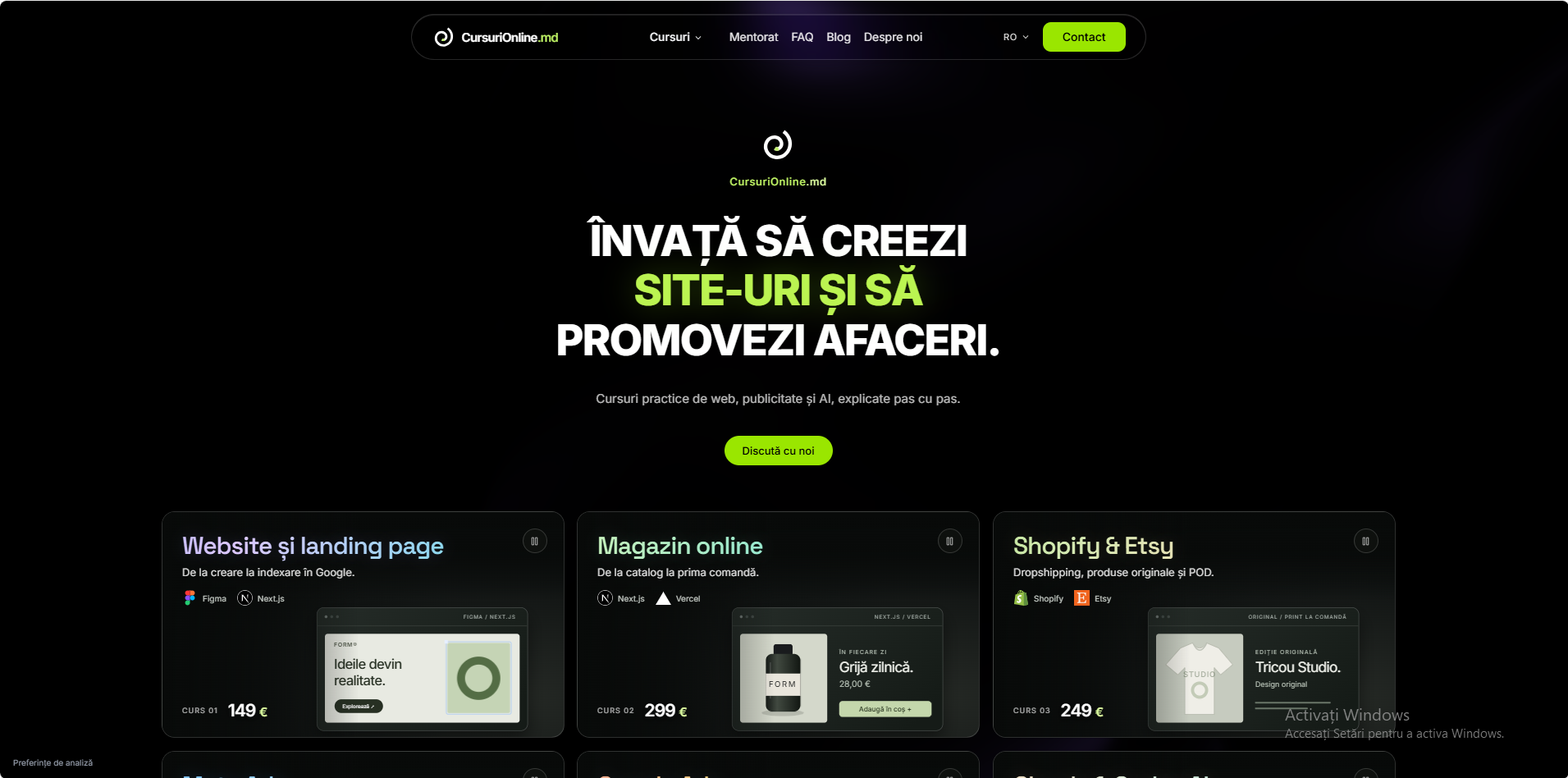
CursuriOnline.md — the interface of the project created and managed by ADS Moldova: the main message, navigation and course cards. Screenshot published on 30 September 2026.
Open the screenshot at its original sizeThe website uses a dark background, lime accents and strong headings while leaving space for explanations. Course cards include thematic illustrations and visual references to tools. These elements help visitors recognise the subject: an interface for a website, a product for an online store or a promotional context for advertising. The supplied screenshot shows how the main message, contact action and catalogue relate to one another.
Navigation brings together courses, mentoring, frequently asked questions, the blog and information about the project. The main screen explains what visitors can learn, and the contact action remains easy to find. Romanian, Russian and English versions provide entry points for different audiences. Design should support choosing and reading, including on a phone. Its purpose extends beyond creating an attractive opening screenshot: visitors need to find the programme and understand how to discuss the appropriate format.
Individual mentoring for a specific objective
Alongside its video course offer, the project presents individual mentoring on Zoom. Participants choose a direction, while the package defines the time and level of support. The conversation starts with current experience, the objective and availability. Building a first page and correcting an existing published project call for different explanations, so the starting point should be discussed before arranging the work.
A session becomes more useful when there is something concrete to examine: a brief, a sketch, a reproducible error or a question about structure. Between meetings, participants apply the explanations and prepare further questions. Video courses, tools and advertising budgets are discussed separately from mentoring under the selected offer. The dedicated page allows visitors to compare packages and understand the process, making the initial request more precise about time, feedback and independent practice.
Explaining enrolment before payment
In the current public version, enrolment and payment details are discussed through WhatsApp. Material availability, the access method and the mentoring schedule are confirmed before payment. Automatic video access is not yet active on the website. We state this stage explicitly so that visitors understand what happens after selecting the contact button. The catalogue introduces the offer and leads to a discussion of conditions.
The FAQ section adds answers about starting level, equipment, personal projects and enrolment. It reduces questions that would otherwise have to be repeated in every conversation. For an educational product still developing, clear conditions are part of the experience alongside the interface. Publishing a catalogue and delivering access to learning materials are separate stages, and describing both accurately helps people choose a format and prepare for the work ahead.
How a business could use the project
Consider a hypothetical workshop that wants more complete enquiries for made-to-order work. A useful first exercise could be a page with examples, the service area and a form requesting approximate dimensions. The participant learns to explain the offer, organise information and check what reaches the person responding. The work has a practical purpose that can be tested through a sample submission and a review of the received information.
Promotion can then be considered more precisely: which message attracts an appropriate audience, and which questions remain unanswered on the page? Repeated delivery questions suggest an opportunity to improve the content. Incomplete enquiries may reveal a need to adjust the form. This is a learning scenario, not a commercial outcome already measured for students. The intended value is the ability to connect technical choices to actual business activity and improve a project using specific observations.
A blog, tools and examples for continued learning
The blog provides room for explanations that do not fit inside a course card. The tools catalogue can help participants understand what applications do before choosing a working set. In this context, tools are ways to carry out a task. A collection of accounts and subscriptions does not replace requirements, practice or verification. It is more useful to identify the action needed and then select an appropriate tool.
ADS Moldova projects also provide public examples to study. A participant can compare a marketplace with a service page or an AI product, follow the visitor’s main actions and consider why the structures differ. They can examine what information visitors receive, where an action starts and how the presentation adapts to each product. In the CursuriOnline.md case study, we describe our contribution and explain how the catalogue, mentoring and editorial content complement each other.
What matters in the next stage
The project’s direction is to make learning clearer and easier to apply. Progress can be observed in the quality of a piece of work, the ability to identify an error and the explanation of a decision. Client numbers, income and advertising results depend on several factors and are not guaranteed outcomes of completing a course. Early progress is better assessed through actions a participant can independently repeat and check.
We suggest starting with a manageable objective: a working page, a demonstration catalogue or a campaign prepared for review. Choose a direction, read the programme and describe your current level. CursuriOnline.md adds an educational component to the projects created and managed by ADS Moldova. Implementation experience becomes a starting point for people who want to build and understand their own digital products, make better-informed choices and collaborate more confidently with other professionals.
Sources and documentation
Your notes
Notes stay in this browser.