ADS Moldova’s calculator and Dina: prepare a clear project enquiry
Use the estimate, Dina assistant and package descriptions to prepare a useful brief. Learn what to confirm in a quotation and how to interpret public reviews.
Contents
“I want a modern website” starts a conversation but does not yet support a precise quotation. The team needs to understand what you will present, what visitors can do and who will maintain the project after launch. Planning tools help when they clarify those details.
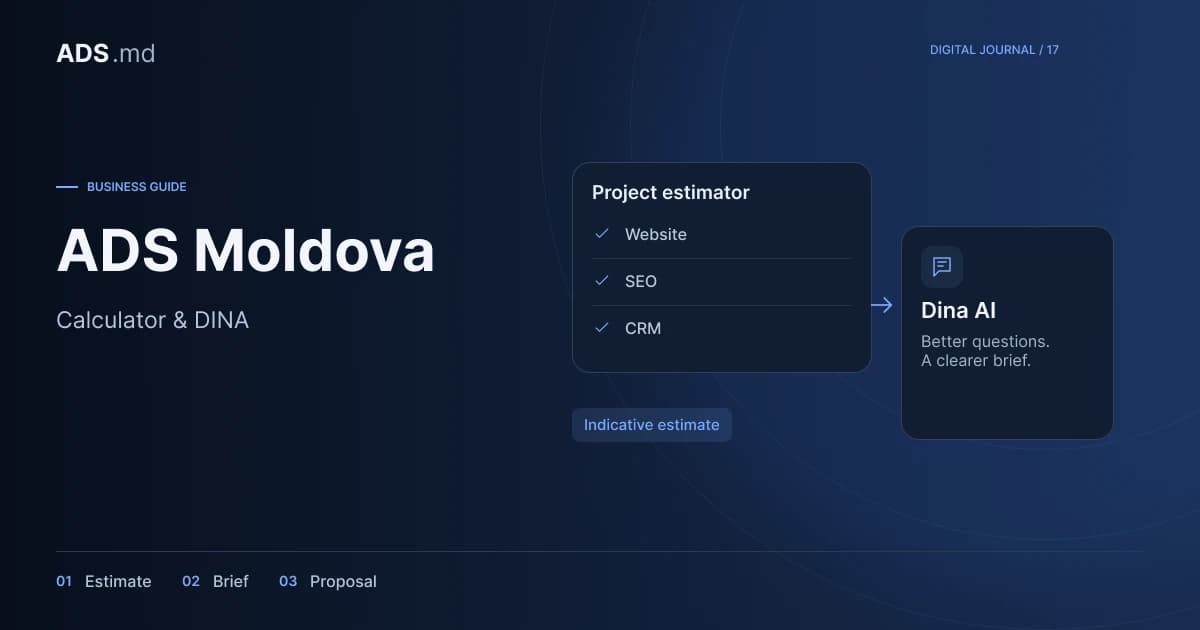
ADS Moldova’s calculator, Dina assistant and service pages serve different purposes. The calculator organizes selection and estimates, Dina can clarify questions, and an agreed quotation establishes deliverables. This guide explains their use without attributing unmeasured sales increases to platform updates.
Prepare three starting facts
Write down the objective, current situation and desired customer action. A workshop might already have photographs and a social page but receive enquiries without the dimensions needed for pricing. In that example, the form and project presentation matter more than a long list of integrations.
Add known constraints: indicative budget, deadline, languages and the person who approves material. Mark missing information as a question. Saying photographs still need to be produced is more useful than selecting a package under the assumption that all content is ready.
Separate launch requirements from later improvements. A working catalogue may take priority over advanced automation. This distinction allows staged discussion without turning an initial estimate into a promise to deliver a much larger system within the same scope.
Read the estimate as an orientation point
The pricing calculator helps prepare a service selection. In the documented implementation, the estimate uses the catalogue and separates initial from monthly costs. Its output supports discussion; it does not establish a contractual price for every possible project variation.
Check what each line means. A presentation website, shop and migration represent different circumstances even though all involve websites. For a concrete quotation, clarify page count and types, content preparation, required functionality and connections to existing business systems.
Advertising expenditure, domain, hosting and licences need separate confirmation. Check service overlap and confirm which functions are included in your selection. Read the estimate together with the package and its stated boundaries.
Use Dina to clarify questions
Dina is presented as ADS Moldova’s virtual assistant for websites, advertising, SEO, AI and automation. Begin with the problem and ask for explanations of service differences. The assistant provides orientation; final collaboration conditions still require confirmation with the team.
A useful prompt might be: “We have a catalogue and receive orders through messages. What should we clarify before connecting a form to a CRM?”. Request a question list and check whether it fits your business. Do not treat the assistant’s assumptions as established facts about your systems.
Avoid entering passwords, card details or customer information merely to explain an idea. Replace them with fictional examples. If the chat is unavailable, use the direct contact shown; an AI service dependency should not prevent you from preparing the enquiry.
Turn the selection into a reviewable brief
A useful brief connects services to needs. Instead of “website, SEO, AI”, explain which pages you need, what information people should find in search and which questions the assistant would handle. That connection helps the team identify gaps and options that can wait.
Keep requirements separate from preferences. “The form must reach the sales owner” is a requirement; a background animation may be a preference. Both can be discussed, but they do not carry equal priority when time or budget is limited.
Read the prepared message before sending it. Check services, language, indicative amounts and conditions. Automatically prepared wording provides a convenient starting point, but you know the business context and can remove details that do not represent the actual project.
Compare packages through deliverables
Ask for the output of each stage: approved structure, implemented pages, verified form or measurement configuration. Terms such as “complete” and “modern” do not establish boundaries. A meaningful comparison shows what you receive and what you need to supply.
Clarify revisions, account access and responsibility after launch. Who edits wording, pays external providers and receives problem reports? These arrangements can matter more to collaboration than a small difference between two preliminary figures.
Do not confuse deliverables with guaranteed commercial outcomes. A page and form can be technically verified; future customer numbers also depend on the offer, demand and enquiry handling. Agree separately on what will be built and what will be monitored after publication.
Use reviews for context
The ADS Moldova Trustpilot profile provides a place for public feedback. Read the observations in context without assuming that a profile certifies every service. Scores and review counts can change, so this guide does not present them as permanent facts.
Compare feedback with the portfolio and written proposal. Consider whether the experience concerns a similar project and what the reviewer actually praises or criticizes. An individual review does not replace clarifying the timeline and responsibilities for your own collaboration.
Check the full journey to contact
On a phone, test selecting services, reading the estimate and opening the contact channel. Visual effects should confirm actions while keeping text readable. If animation interrupts interaction or hides a result, address that problem before promoting the tool.
Preparation is complete when the team can respond to a concrete enquiry: objective, deliverables, missing information and next step. The calculator and Dina reduce the effort of expressing an idea, but a final quotation still needs the actual context and an agreed scope of work.
Sources and documentation
Your notes
Notes stay in this browser.