Bonusuri.md: from a task to a verified reward
Bonusuri.md connects the company publishing a task, the participant completing it and the administrator checking the evidence. The central requirement was a clear path between an activity and its reward.
- ADS Moldova’s role
- Web platform, role-based dashboards and validation workflows.
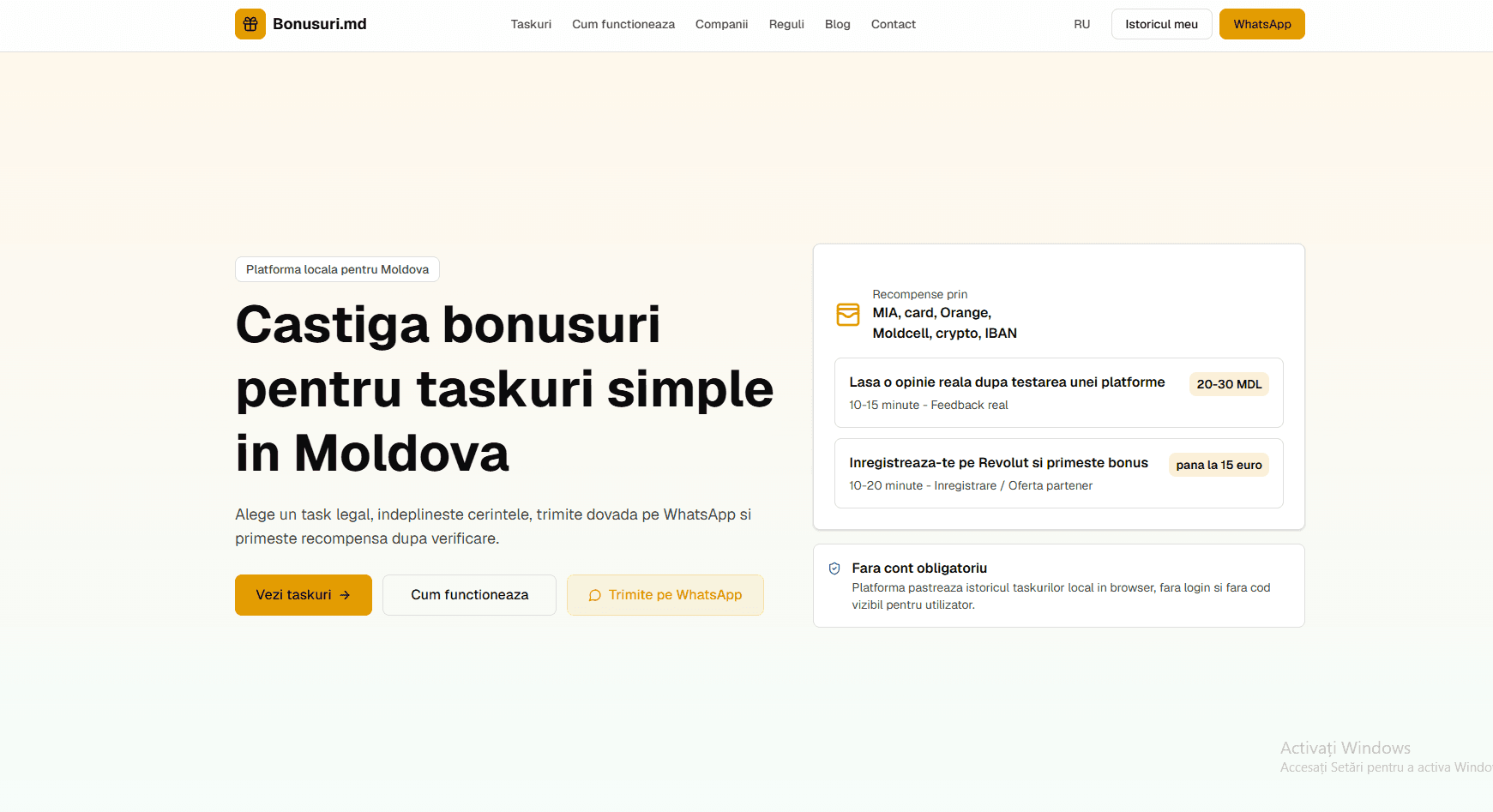
An explicit state for each step
Publishing, participation, evidence submission and review are separate stages. Participants can follow their task status, while administrators have the information needed to accept evidence or request clarification.
Three roles, different dashboards
Companies follow campaigns, participants manage their tasks and administrators review activity and rewards. Evidence uploads are designed for phones. Some actions also support a WhatsApp route without mandatory login.
The task as the unit of work
The central information unit in Bonusuri.md is a task. A company describes an activity, a participant needs to understand what to do, and an administrator needs a reference for reviewing it. If those perspectives are not connected by the same requirement, evidence may be uploaded successfully yet remain insufficient for approval. The platform structure starts with this relationship between an instruction and its assessment.
An example is an activity that requires confirmation of a particular action. The participant reads the requirement and supplies supporting material; review then refers back to that task. This explains why publishing and approval are separate stages. Opening an activity or beginning participation is different from completing the work and having its associated reward validated by the reviewing administrator.
Evidence has a journey of its own
Submitting evidence is an important moment for a participant: the activity has been carried out, but review still follows. The interface needs to keep that distinction visible. Explicit task states give participants and administrators a shared vocabulary, so a question can concern the current step rather than an untraceable situation.
For an administrator, supporting material is useful in the context of the original requirement. Acceptance or a request for clarification relates to the submitted information and the task conditions. From an interface perspective, this justifies keeping the activity description connected with the material under review. The case focuses on organizing that validation work. Participation is not automatically presented as a measured commercial result for the company that published the activity; those are separate evaluations.
Different views for different responsibilities
A single dashboard containing every possible action would mix distinct responsibilities. A company follows the activities it publishes, a participant manages personal tasks, and an administrator reviews evidence and rewards. Separate dashboards reflect those purposes and make the next action easier to understand for each role.
For participants, the phone experience matters particularly when the evidence already exists on the device. Mobile-friendly submission connects carrying out an activity with providing the material needed for review. A WhatsApp route provides an alternative entry point for some actions. That option does not change the validation logic: an enquiry still needs to relate to an activity, and the information required for assessment must remain understandable to the team receiving it. Accessible submission and coherent processing serve the same task journey.
A reward completes a traceable process
A reward is connected to an activity and the review of its evidence, rather than simply to the existence of a user account. This order gives the product its purpose. Before discussing the number of participants or tasks, the case explains how an activity becomes recognized as completed. That is what distinguishes Bonusuri.md from a basic list of offers.
For a company considering a similar platform, the project shows why roles and decision points belong in the interface structure from the beginning. Publication, participation, evidence and review each involve different information. Bringing them together supports activity tracking and gives administrators a working framework. The documented result is this operational structure, with identifiable steps and responsibilities for the company, the participant and the person reviewing the submitted activity.
What the project provides
Tasks, evidence and rewards share one workflow. Separate dashboards show the actions relevant to each role.