CPA and CPL: what you pay for and how to verify the result
Distinguish cost per enquiry, cost per customer and agency fees. A practical guide to definitions, duplicates, validation and collaboration based on verifiable records.
Contents
“Payment for results” can describe a reporting metric, a bidding strategy or the way an agency is compensated. These meanings are different. Before comparing proposals, ask for the exact outcome definition, included costs and enquiry acceptance process. An identical abbreviation does not establish identical commercial terms.
A low CPL may conceal unsuitable requests, while a platform CPA may count something other than a confirmed sale. This guide provides a practical discussion and verification method. Its numerical examples are hypothetical, illustrating calculations without describing an actual client's performance or promising future campaign efficiency.
Define the event behind each metric
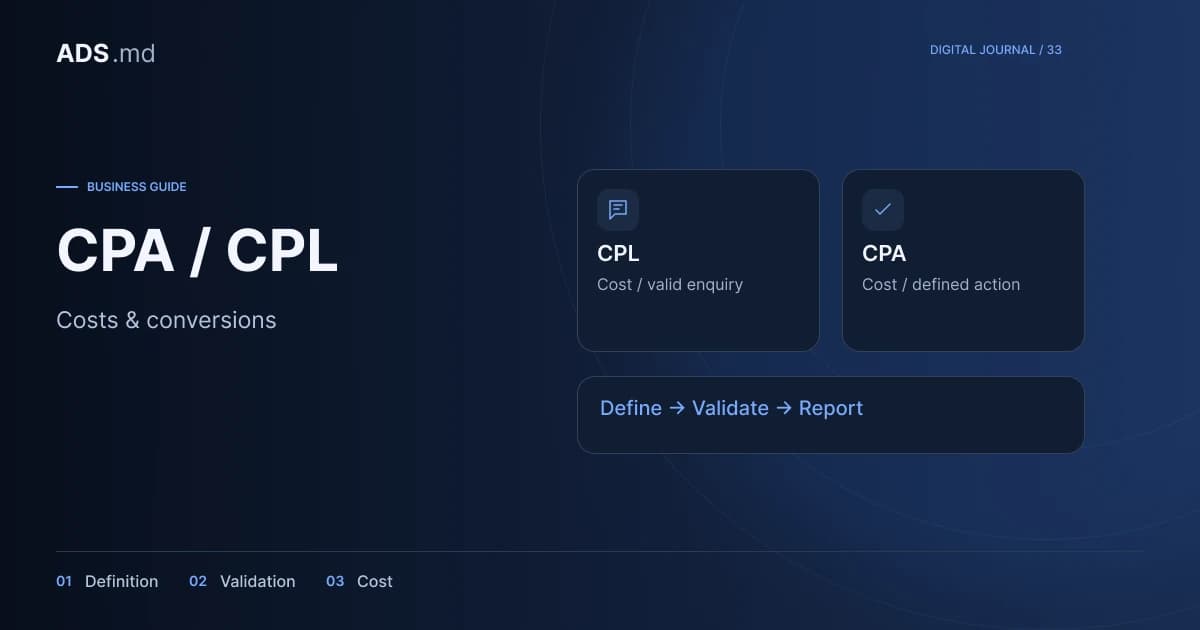
CPL means cost per lead, but “lead” needs an operational definition. It could mean a received enquiry, a validated request or someone qualified for a proposal. CPA concerns the action or acquisition defined in that context. Name the event in ordinary language before relying on its abbreviation in a report.
For a hypothetical workshop, a valid request could contain a usable reply channel and a project within its services. A customer could be defined by a confirmed order under the company's process. One person submitting twice should not automatically become two customers. Decide how to identify repeated projects and distinguish them from new requests.
Separate bidding from the commercial agreement
A bidding strategy pursues an objective inside an advertising system. It is different from an agreement where an agency invoices only accepted results. Google's Target CPA documentation explains that the target guides bidding without guaranteeing an identical cost for every conversion.
When discussing a proposal, request three distinct lines: platform spending, service fees and other execution costs. If compensation has a variable component, specify what triggers it. Combining everything into one number makes comparison difficult and conceals which costs would change if the volume of activity increased.
Calculate on a consistent basis
In an exercise, advertising costs 1,000 monetary units and the team confirms 20 distinct enquiries. Advertising CPL is 50. If five become confirmed customers, advertising cost per customer is 200. These figures show the relationship between stages without establishing a good benchmark for every business or service.
Adding fees, materials and other expenses changes the calculation basis. Label that basis explicitly. Compare an agreed period and remember that an enquiry may become an order later. Do not silently combine one month's full expenditure with another period's sales; explain the method before interpreting the resulting metric.
Agree validation criteria before launch
Criteria should be observable and connected to the offer: an available service, a served location, usable contact details and no duplication. Avoid rejecting requests based on impressions that cannot be checked. “I did not like the conversation” does not establish whether the enquiry met criteria agreed before advertising began.
Prepare example cases:
- A suitable customer postpones the decision.
- Someone requests a service outside the offer.
- The same project generates repeated contacts.
- Details are invalid or the submission is automated.
- A relevant request receives no response from the team.
These situations should not be treated identically. A suitable enquiry lost through lack of response indicates an operational issue. An automated form submission indicates something else. Separate reasons support improvement and prevent the same label being applied to every case that ultimately did not become a commercial success.
Connect platform measurement with business records
A phone click, opening WhatsApp and visiting a thank-you page do not independently confirm a sale. Define technical events around actions the system can verify. A saved enquiry and an accepted contract must remain distinct stages even when both matter to the team and inform analysis of the customer journey.
GA4 documents generate_lead for a lead-generation action. Configuration must match the definition and applicable consent. Use suitable operational identifiers without transmitting personal details or free-text descriptions to analytics tools. Check repeated submissions separately from the creation of a genuinely new request.
Assign responsibilities after first contact
Marketing can introduce an enquiry, but the offer, availability and staff response also influence continuation. Establish who owns the request and how contact outcomes are recorded. If calls go unanswered, advertising metrics alone cannot explain why someone did not become a customer or what operational change is needed.
Choose an evaluation period appropriate to the process and record pending cases. A renovation project may require several discussions rather than a simple purchasing decision. Do not close every recent enquiry as lost merely to finish the current report quickly. Preserve the state reflecting the actual conversation and the customer's known intentions.
Reconcile reporting before calculating payment
Compare the enquiry list with team records and remove duplicates under the agreed rule. Keep the reason for each adjustment and its validation time. Participants should be able to follow one request without repeated exchanges of screenshots and vaguely named files. A clear record reduces recurring disputes about handling facts.
Do not add results claimed by several platforms as though they were different customers. Attribution can connect one order with several interactions. Commercial records confirm distinct entities, while advertising reports help investigate channel contribution. Reconcile these perspectives while preserving their meaning instead of quietly substituting one for the other.
Decide whether the model supports collaboration
An outcome-based model is easier to maintain when definitions, data access and responsibilities are clear. With low volume or a long sales cycle, begin with enough observation to understand the process. Missing evidence should not become a commercial guarantee that neither side can subsequently verify.
After the exercise, both parties should be able to explain what is accepted, how cost is calculated and what can be disputed with evidence. That clarity makes proposal comparisons more useful than a minimum-CPL promise that leaves quality, included costs and post-contact work undefined. It also creates a shared basis for improving the customer acquisition process.
Sources and documentation
Your notes
Notes stay in this browser.