AI Moldova, Bonusuri and MDStore: choosing where to start
Three products with different purposes: AI work, verified tasks and creative commerce. Understand each role and plan its connection to your website, marketing and team.
Contents
A business may need commercial copy, observations about a website or a place to present products. These requirements only look similar at a distance. Choosing a tool becomes easier when you start with the actual activity and identify who will use its output.
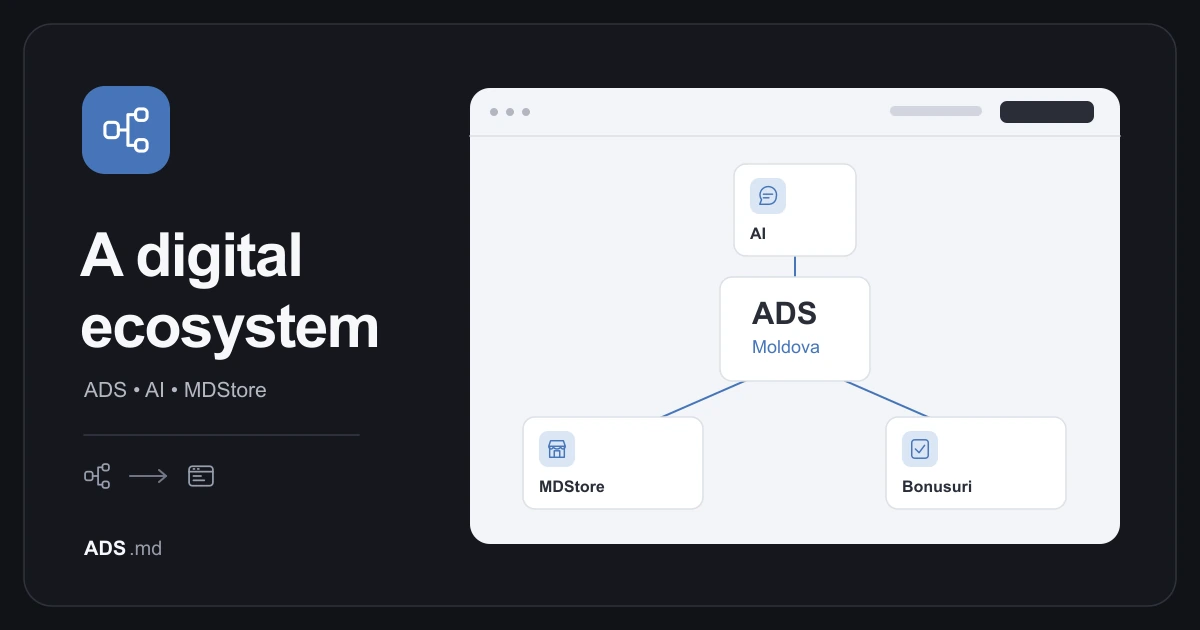
AI Moldova, Bonusuri.md and MDStore are projects with their own identities and workflows in the ADS Moldova portfolio. A shared ecosystem does not automatically mean a shared account, synchronized data or integrations between every platform. This guide separates documented functions from connections a business still needs to design.
Identify the problem before choosing a product
Write one sentence describing the current obstacle. “We need digital transformation” does not establish an action. “Customers do not understand commission conditions” or “staff keep rewriting the same replies” identifies a starting point and the people who need to help resolve it.
Then define a useful output: a reviewed document, a list of observed problems or an organized order enquiry. Opening an account is not itself a success measure. A tool becomes useful when it changes a particular activity and the team can actually use what it produces.
Record where the tool’s responsibility ends. Generated wording needs review, task evidence needs evaluation, and an order needs fulfilment. People and rules remain necessary for those stages. Connecting several products under one commercial presentation does not make those responsibilities disappear.
AI Moldova: from a question to working material
AI Moldova presents chat, documents, images and marketing ideas with a Romanian, Russian and English interface and a PWA. The portfolio describes it as a product in development. Check feature availability and plan conditions before incorporating it into a critical workflow.
For an initial task, provide specific context: business type, audience, objective and available material. Request a bounded output, such as an offer outline you will review. A fluent response can still contain mistaken assumptions about your service, so confident wording is not a substitute for verification.
Separate producing material from executing an action. Drafting a message does not send it, and a website outline does not establish a working public application. When implementation is needed, turn the output into a brief and agree deliverables with the responsible team.
Bonusuri.md: an activity with evidence and review
Bonusuri.md organizes tasks, evidence and reward verification. The project documentation distinguishes company, participant and administrator roles. Some activities offer a WhatsApp route; that does not remove the need to associate submitted evidence with the exact task requirement.
One possible use is a private page test: the participant searches for information and describes a difficulty. Specify what they should attempt and what observation you need. Avoid requesting positive feedback, which would undermine the information required to improve the experience.
Do not confuse rewarded participation with spontaneous commercial demand. A task visit does not demonstrate buying intent or justify search ranking promises. Analyze collected observations separately from real customer behaviour, because they answer different questions and should not share an undifferentiated success measure.
MDStore: an existing product or a commission
MDStore brings together art, handmade and digital creators. The portfolio documents creator profiles, product moderation and two journeys: selecting a catalogue item or discussing a commission through a request, offer and counteroffer.
For an existing product, prepare photographs, dimensions, materials, availability and delivery conditions. For a commission, prepare the questions needed to define the work. Budget, format and timing require context; an attractive description cannot replace agreement on what the creator will deliver.
The creator profile provides continuity between products and their author. Present your contribution and material you have permission to publish. Catalogue approval is an administrative stage, not an absolute guarantee of every outcome or a match for every buyer’s preferences.
Design the connection with ADS Moldova services
A website explains the offer, promotion brings people to it, and enquiry records help the team continue the conversation. Define the connection concretely: which page, message, form and responsible person. A catalogue of available services is not, by itself, an operating process.
As an exercise, a workshop could use AI for description drafts, private feedback to assess a page and a catalogue to present products. This is a planning scenario, not a documented automatic integration between the three platforms. Each information transfer needs its own definition.
Start with one manageable connection: a link to the relevant product or a brief handed to the team. Automate only after checking data meaning, access and responsibility. More connections also create more situations to maintain when one component changes.
Assign ownership of data and decisions
For every stage, record who can see information and who can change the work’s status. Marketing assets, task evidence and order details serve different purposes. Do not assume they can be copied between platforms simply because the products appear together in a portfolio.
Keep test information separate from customer data. Use fictional or authorized material for demonstrations. In an actual project, document what is transferred, how long it is retained and how the team handles requests; configuration should reflect real use rather than a convenient presentation diagram.
Choose a pilot that leads to a decision
Define a small trial: one document, one feedback scenario or one fully described product. Establish what you want to learn and what an acceptable result means. Compare usefulness, staff effort and observed problems rather than counting every recorded action as equally valuable.
After the pilot, decide what to continue, what to improve and what is not yet necessary. A digital ecosystem works through clear roles and explained handoffs. The appropriate starting point solves a current problem and can be supported in everyday work.
Sources and documentation
Your notes
Notes stay in this browser.